
Is SSA a Congruence Theorem? (Side-Side-Angle Ambiguity)
SSA
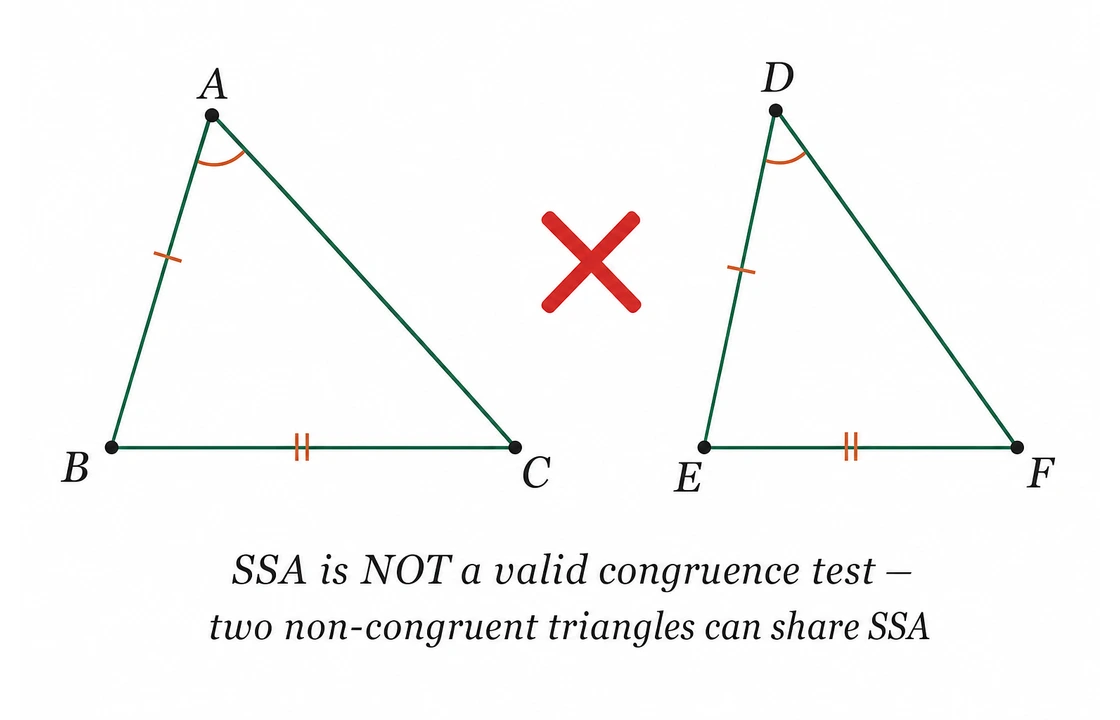
Side-side-angle. This is NOT one of the congruence tests or similarity tests for triangles. The fact that two triangles have congruent corresponding angles and sides as shown below does not mean that the triangles are congruent.
Note: When a SSA correspondence exists there are often two possible configurations for the triangles.
See also
Key Formula
sinB=absinA
Where:
- A = The given angle (the angle you know)
- a = The side opposite the given angle A
- b = The other given side (adjacent to angle A)
- B = The angle opposite side b, which you are solving for
Worked Example
Problem: In triangle ABC, angle A = 30°, side b = 10, and side a = 6. Determine how many triangles are possible.
Step 1: Identify the SSA configuration. You know angle A, the side adjacent to it (b), and the side opposite it (a). Use the Law of Sines to find angle B.
sinB=absinA=610⋅sin30°
Step 2: Calculate the value of sin B.
sinB=610⋅0.5=65≈0.8333
Step 3: Since 0 < sin B < 1, there are potentially two solutions for angle B. Find both.
B1=sin−1(0.8333)≈56.4°andB2=180°−56.4°≈123.6°
Step 4: Check that each candidate for B, when added to A, gives a sum less than 180°.
A+B1=30°+56.4°=86.4°<180°✓
Step 5: Check the second candidate as well.
A+B2=30°+123.6°=153.6°<180°✓
Answer: Two different triangles are possible. This is the classic ambiguous case: the same SSA information produces two valid, non-congruent triangles.
Another Example
This example shows the case where SSA information yields zero triangles, unlike the first example which yielded two. It demonstrates why SSA is unreliable — the same type of given information can produce 0, 1, or 2 triangles.
Problem: In triangle ABC, angle A = 40°, side b = 8, and side a = 4. Determine how many triangles are possible.
Step 1: Apply the Law of Sines to find sin B.
sinB=absinA=48⋅sin40°
Step 2: Calculate the numerical value.
sinB=48⋅0.6428=45.1423≈1.2856
Step 3: Since sin B > 1, no real angle B exists. The sine of any angle must be between −1 and 1.
sinB≈1.2856>1⟹No triangle exists
Answer: No triangle can be formed with these measurements. The side opposite the known angle is too short to reach the other side.
Frequently Asked Questions
Why is SSA not a congruence theorem?
SSA fails as a congruence theorem because knowing two sides and a non-included angle does not uniquely determine a triangle. The ambiguous case shows that the same SSA measurements can correspond to two differently shaped triangles, so you cannot conclude the triangles are congruent. Valid congruence tests (SSS, SAS, ASA, AAS) always produce exactly one triangle shape.
What is the ambiguous case of the Law of Sines?
The ambiguous case arises when you are given two sides and the angle opposite one of them (SSA). When you use the Law of Sines to solve for the unknown angle, the equation sin B = (b sin A)/a may have two valid solutions (B and 180° − B), one solution, or no solution. You must check each candidate angle to see whether it forms a valid triangle.
When does SSA give exactly one triangle?
SSA gives exactly one triangle in two situations: (1) the side opposite the given angle is exactly long enough to form a right triangle with the other side (sin B = 1, so B = 90°), or (2) the given angle is 90° or greater, in which case only one configuration is geometrically possible. In these special scenarios, the ambiguity disappears.
SSA (Side-Side-Angle) vs. SAS (Side-Angle-Side)
| SSA (Side-Side-Angle) | SAS (Side-Angle-Side) | |
|---|---|---|
| What is given | Two sides and a non-included angle | Two sides and the included angle (the angle between them) |
| Valid congruence test? | No — does not prove congruence | Yes — proves triangles are congruent |
| Number of possible triangles | 0, 1, or 2 triangles possible | Always exactly 1 triangle |
| Key difference | The known angle is NOT between the two known sides | The known angle IS between the two known sides |
| Solving method | Law of Sines (with ambiguity check) | Law of Cosines (no ambiguity) |
Why It Matters
SSA appears frequently in trigonometry courses when students use the Law of Sines to solve triangles. Recognizing an SSA setup is essential because blindly applying the Law of Sines without checking for the ambiguous case can lead to missing a valid solution or accepting an impossible one. On standardized tests and in real-world applications like surveying and navigation, mishandling SSA leads to incorrect measurements.
Common Mistakes
Mistake: Confusing SSA with SAS and assuming it proves congruence.
Correction: In SAS, the angle is between (included by) the two known sides, which guarantees a unique triangle. In SSA, the angle is not between the two sides, so the triangle is not uniquely determined. Always check whether the given angle is included or not.
Mistake: Finding only one value of the unknown angle and ignoring the second possible solution.
Correction: When sin B = k and 0 < k < 1, there are two candidate angles: B = sin⁻¹(k) and B = 180° − sin⁻¹(k). You must test both to see if they produce a valid triangle (i.e., the angle sum stays under 180°). Skipping this check means you may miss a valid triangle.
Related Terms
- Congruence Tests for Triangles — Valid tests (SSS, SAS, ASA, AAS) that SSA fails to join
- Similarity Tests for Triangles — Valid similarity criteria (AA, SAS~, SSS~) for triangles
- Side of a Polygon — The 'S' in SSA refers to sides
- Angle — The 'A' in SSA refers to an angle
- Triangle — The shape SSA attempts to determine
- Congruent — SSA does not guarantee triangle congruence
- Corresponding — SSA involves corresponding sides and angles
- Similar — SSA is also not a valid similarity test