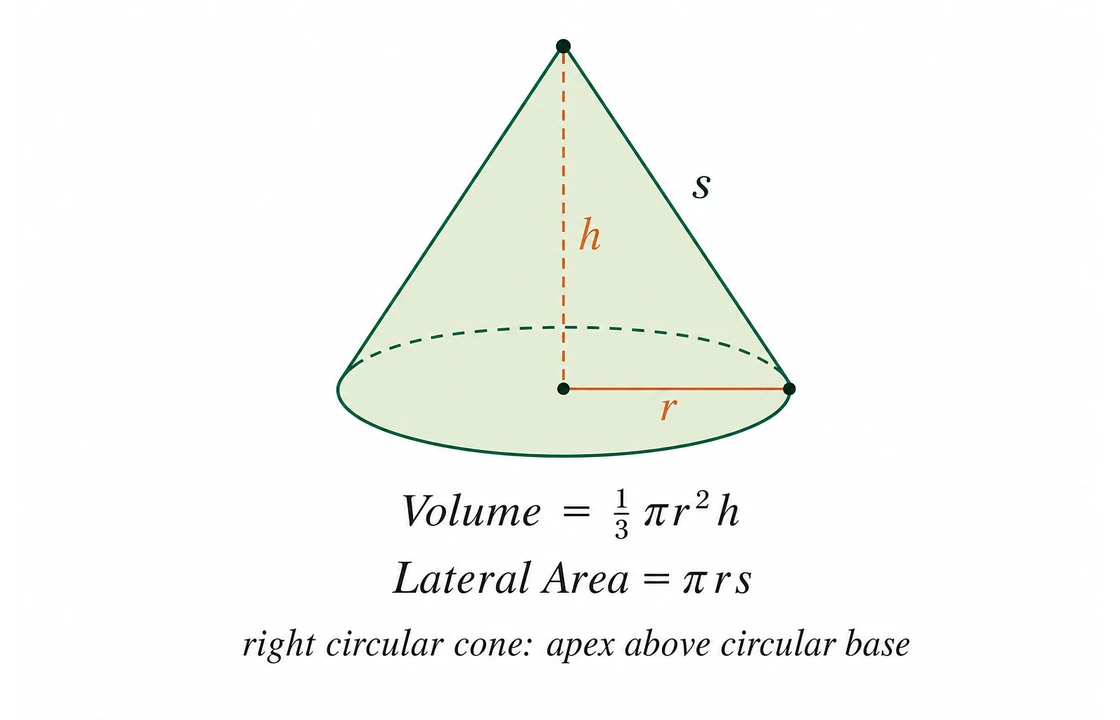
h = Height (altitude) — perpendicular distance from the base to the apex
l = Slant height — distance from the apex to any point on the edge of the base
Alateral = Lateral (side) surface area
Atotal = Total surface area (lateral area plus base area)
Worked Example
Problem: A right circular cone has a base radius of 6 cm and a height of 8 cm. Find its slant height, volume, and total surface area.
Step 1: Find the slant height using the Pythagorean theorem. The radius, height, and slant height form a right triangle.
l=r2+h2=62+82=36+64=100=10 cm
Step 2: Calculate the volume using the cone volume formula.
V=31πr2h=31π(6)2(8)=31π(288)=96π≈301.6 cm3
Step 3: Calculate the lateral surface area.
Alateral=πrl=π(6)(10)=60π≈188.5 cm2
Step 4: Add the base area to get the total surface area.
Atotal=πrl+πr2=60π+36π=96π≈301.6 cm2
Answer: Slant height = 10 cm, Volume = 96π ≈ 301.6 cm³, Total surface area = 96π ≈ 301.6 cm².
Another Example
This example starts with the slant height instead of the height, requiring students to work backward to find the missing dimension before computing volume.
Problem: A right circular cone has a slant height of 13 cm and a base radius of 5 cm. Find the height of the cone and its volume.
Step 1: Find the height from the slant height and radius. Rearrange the Pythagorean relationship.
What is the difference between a right circular cone and an oblique cone?
In a right circular cone, the apex sits directly above the center of the circular base, so the axis is perpendicular to the base. In an oblique cone, the apex is off-center, making the axis tilt. Both have the same volume formula (⅓πr²h, where h is the perpendicular height), but the lateral surface area formula πrl only works for right circular cones because oblique cones lack uniform slant height.
Why is the volume of a cone one-third the volume of a cylinder?
A cylinder with the same base radius and height contains exactly three times as much space as the cone. This can be proven using calculus (integrating cross-sectional areas) or demonstrated with Cavalieri's principle. Intuitively, the cone tapers to a point, so its cross-sectional area shrinks as you move from base to apex, resulting in exactly one-third of the cylinder's volume.
How do you find the slant height of a right circular cone?
The slant height is the hypotenuse of a right triangle formed by the radius and the height of the cone. Use the Pythagorean theorem: l = √(r² + h²). If you know the slant height and one other measurement, you can rearrange to find the missing value.
Right Circular Cone vs. Cylinder
Right Circular Cone
Cylinder
Shape
Tapers from a circular base to a point (apex)
Two parallel, congruent circular bases connected by a curved surface
Volume
V = ⅓πr²h
V = πr²h
Lateral Surface Area
πrl (where l is slant height)
2πrh
Volume relationship
One-third of the cylinder with same base and height
Three times the cone with same base and height
Why It Matters
Right circular cones appear constantly in geometry courses when studying three-dimensional solids, and they are a staple on standardized tests like the SAT and ACT. Beyond the classroom, the shape models everyday objects such as ice cream cones, funnels, traffic cones, and the frustum sections used in engineering. Mastering this shape also prepares you for calculus topics like solids of revolution and related-rates problems.
Common Mistakes
Mistake: Confusing the height (h) with the slant height (l) when calculating volume.
Correction: The volume formula V = ⅓πr²h requires the perpendicular height from the base to the apex, not the slant height along the side. If you are given the slant height, first compute h = √(l² − r²) before plugging into the volume formula.
Mistake: Forgetting to include the base area when asked for total surface area.
Correction: The lateral surface area πrl covers only the curved side. Total surface area also includes the circular base: A_total = πrl + πr². Read the problem carefully to determine which quantity is being asked for.
Related Terms
Right Cone — General right cone; circular base makes it a right circular cone
Cone — Broader category including oblique and non-circular cones
Circular Cone — Circular base cone that may be right or oblique
Slant Height — Distance from apex to base edge, key measurement