
Right Cone: Volume V = ⅓πr²h, Surface Area & Examples
Right Cone
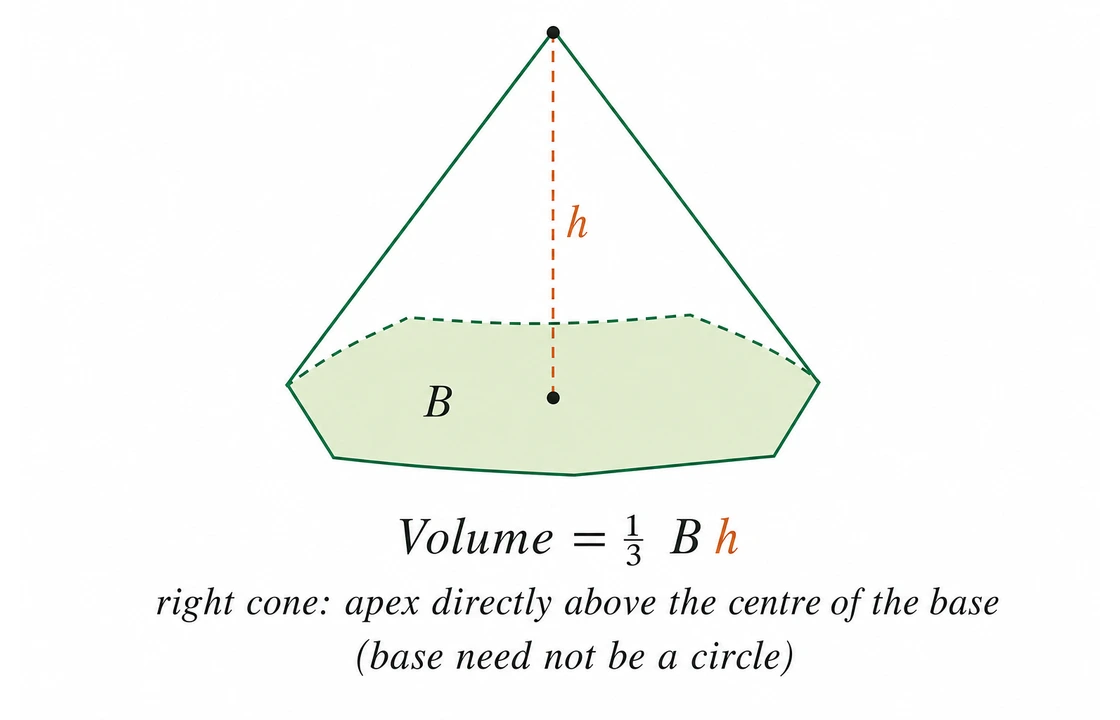
A cone that has its apex aligned directly above the center of its base. The base need not be a circle.
See also
Key Formula
V=31Bhand for a right circular cone:V=31πr2h
Where:
- V = Volume of the right cone
- B = Area of the base (any shape)
- h = Height (altitude) — the perpendicular distance from the base to the apex
- r = Radius of the circular base (right circular cone only)
- π = Pi, approximately 3.14159
Worked Example
Problem: Find the volume and lateral surface area of a right circular cone with radius 6 cm and height 8 cm.
Step 1: Identify the given values: radius r = 6 cm and height h = 8 cm.
r=6,h=8
Step 2: Calculate the volume using the right circular cone formula.
V=31πr2h=31π(6)2(8)=31π(288)=96π≈301.6 cm3
Step 3: Find the slant height using the Pythagorean theorem. Because the cone is a right cone, the height, radius, and slant height form a right triangle.
l=r2+h2=36+64=100=10 cm
Step 4: Calculate the lateral (side) surface area.
Alateral=πrl=π(6)(10)=60π≈188.5 cm2
Answer: The volume is 96π≈301.6 cm³ and the lateral surface area is 60π≈188.5 cm².
Another Example
This example uses a non-circular (square) base to illustrate that a right cone does not require a circular base. The general volume formula V = (1/3)Bh applies regardless of base shape.
Problem: A right cone has a square base with side length 10 m and a height of 12 m. Find its volume.
Step 1: This is a right cone with a non-circular base (a square). First, find the area of the square base.
B=s2=102=100 m2
Step 2: The apex is directly above the center of the square, making it a right cone. Apply the general cone volume formula.
V=31Bh=31(100)(12)
Step 3: Compute the volume.
V=31200=400 m3
Answer: The volume of the right cone with a square base is 400 m³.
Frequently Asked Questions
What is the difference between a right cone and an oblique cone?
In a right cone, the apex sits directly above the center of the base, meaning the altitude is perpendicular to the base. In an oblique cone, the apex is off-center, so the altitude tilts to one side. Both have the same volume formula V = (1/3)Bh, but calculating slant height and surface area is simpler for a right cone because of its symmetry.
Does a right cone always have a circular base?
No. The definition of a right cone only requires the apex to be directly above the center of the base. The base can be a circle, ellipse, square, or any other shape. However, in most textbook problems, 'right cone' refers to a right circular cone unless stated otherwise.
How do you find the slant height of a right circular cone?
Because the apex is directly above the center, the height h, the radius r, and the slant height l form a right triangle. You use the Pythagorean theorem: l=r2+h2. This relationship only works cleanly for a right circular cone, not for an oblique one.
Right Cone vs. Oblique Cone
| Right Cone | Oblique Cone | |
|---|---|---|
| Apex position | Directly above the center of the base | Off-center; not directly above the base center |
| Altitude | Perpendicular to the base and passes through its center | Still perpendicular to the base, but does not pass through the base center |
| Volume formula | V = (1/3)Bh | V = (1/3)Bh (same formula) |
| Slant height | Uniform around the base (for circular base); found via Pythagorean theorem | Varies around the base; no single slant height value |
| Lateral surface area (circular base) | πrl — straightforward formula | No simple closed-form formula; requires integration or approximation |
| Symmetry | Axis of symmetry along the altitude | No axis of symmetry in general |
Why It Matters
Right cones appear constantly in geometry courses when you study volumes and surface areas of solids. Real-world objects like traffic cones, ice cream cones, and funnels are modeled as right circular cones. Understanding the right cone also prepares you for calculus topics like solids of revolution, where rotating a right triangle around an axis generates a right circular cone.
Common Mistakes
Mistake: Confusing the height (altitude) with the slant height when calculating volume.
Correction: The volume formula V = (1/3)πr²h uses the perpendicular height h, not the slant height l. If you are given the slant height, first use h = √(l² − r²) to find the height before plugging into the volume formula.
Mistake: Assuming a right cone must have a circular base.
Correction: A right cone only requires the apex to be directly above the center of the base. The base can be any shape — a pyramid with a square base and apex above the center is technically a right cone. In practice, always check whether the problem specifies the base shape.
Related Terms
- Cone — General term; right cone is a special case
- Oblique Cone — Cone whose apex is not above the base center
- Apex — The tip point of the cone
- Base — The flat face opposite the apex
- Altitude of a Cone — Perpendicular distance from apex to base
- Right Circular Cylinder — Analogous 'right' solid with circular cross-section
- Volume — Key measurement calculated for cones
- Circle — Most common base shape of a right cone