c = The x-value where the relative maximum occurs (a critical point)
f′(c) = The first derivative evaluated at c; equals zero at a critical point
f′′(c) = The second derivative evaluated at c; if negative, the graph is concave down, confirming a relative maximum
Worked Example
Problem: Find all relative maximum values of f(x) = -x³ + 3x.
Step 1: Find the first derivative and set it equal to zero to locate critical points.
f′(x)=−3x2+3=0
Step 2: Solve for x.
−3x2+3=0⟹x2=1⟹x=−1 or x=1
Step 3: Find the second derivative and evaluate it at each critical point.
f′′(x)=−6x
Step 4: Test x = 1: since f''(1) = -6 < 0, the graph is concave down at x = 1, so this is a relative maximum. Test x = -1: since f''(-1) = 6 > 0, the graph is concave up, so this is a relative minimum.
Step 5: Compute the function value at the relative maximum.
f(1)=−(1)3+3(1)=2
Answer: The function has a relative maximum of 2 at x = 1, meaning the point (1, 2) is the relative maximum.
Another Example
This example uses the first derivative test instead of the second derivative test, and involves a polynomial with three critical points — showing that a function can have both relative maxima and relative minima.
Problem: Find the relative maximum of f(x) = x⁴ − 8x² + 12 using the first derivative test.
Step 1: Find the first derivative and set it equal to zero.
f′(x)=4x3−16x=4x(x2−4)=4x(x−2)(x+2)=0
Step 2: The critical points are x = -2, x = 0, and x = 2.
x=−2,x=0,x=2
Step 3: Apply the first derivative test by checking the sign of f'(x) in each interval. Pick test values: x = -3, -1, 1, 3.
f′(−3)=−60<0,f′(−1)=12>0,f′(1)=−12<0,f′(3)=60>0
Step 4: At x = 0, f'(x) changes from positive to negative (+ to −), which means f has a relative maximum there. At x = −2 and x = 2, f'(x) changes from negative to positive, giving relative minimums.
Sign pattern: x=−2−→+x=0+→−x=2−→+
Step 5: Evaluate the function at the relative maximum.
f(0)=0−0+12=12
Answer: The function has a relative maximum of 12 at x = 0, at the point (0, 12).
Frequently Asked Questions
What is the difference between a relative maximum and an absolute maximum?
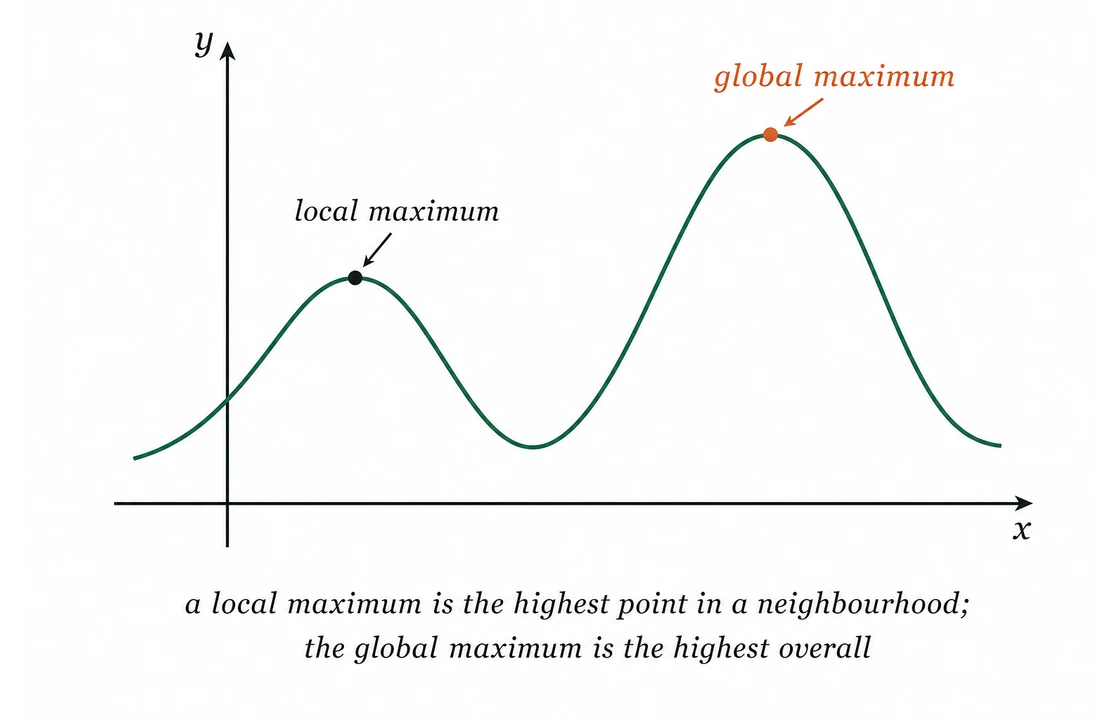
A relative maximum is the highest point compared to nearby points — the function could be even higher somewhere else on its domain. An absolute maximum is the single highest value the function attains over its entire domain. Every absolute maximum is also a relative maximum (in most cases), but a relative maximum is not necessarily an absolute maximum.
Can a function have more than one relative maximum?
Yes. A function can have multiple relative maxima. For instance, a polynomial of degree 4 or higher can have two or more peaks. Each peak is a relative maximum as long as the function value there is higher than at all surrounding points.
Does a relative maximum always occur where the derivative is zero?
Not always. A relative maximum can also occur at a point where the derivative is undefined, such as a cusp or a corner. These are still critical points. The key requirement is that the function value at that point is greater than the values at all nearby points.
Relative Maximum vs. Absolute Maximum
Relative Maximum
Absolute Maximum
Definition
Highest value in a local neighborhood around a point
Highest value of the function over its entire domain
How many can exist
A function can have multiple relative maxima
A function has at most one absolute maximum value (though it may occur at multiple x-values)
How to find
First or second derivative test at critical points
Compare all relative maxima and endpoint values; the largest is the absolute maximum
Must it exist?
Not guaranteed — e.g., f(x) = x has no relative maximum
Guaranteed on a closed interval by the Extreme Value Theorem (for continuous functions)
Why It Matters
Relative maxima appear throughout calculus whenever you optimize a quantity — finding the peak profit, the highest point of a projectile, or the maximum concentration of a drug in the bloodstream. In AP Calculus, you are expected to find relative maxima using both the first and second derivative tests, and to distinguish them from absolute maxima. Understanding this concept is also essential for accurately sketching the shape of a function's graph.
Common Mistakes
Mistake: Assuming every point where f'(x) = 0 is a relative maximum.
Correction: A zero derivative only identifies a critical point. You must verify with the first or second derivative test. For example, f(x) = x³ has f'(0) = 0, but x = 0 is neither a maximum nor a minimum — it is an inflection point.
Mistake: Confusing a relative maximum with an absolute maximum.
Correction: A relative maximum is only the highest value in its immediate vicinity. The function may reach a higher value elsewhere. On a closed interval, always compare relative maxima with the function values at the endpoints to determine the absolute maximum.
Related Terms
Relative Minimum — The lowest point in a local section of a graph