
Essential Discontinuity — Definition, Examples & Types
Essential Discontinuity
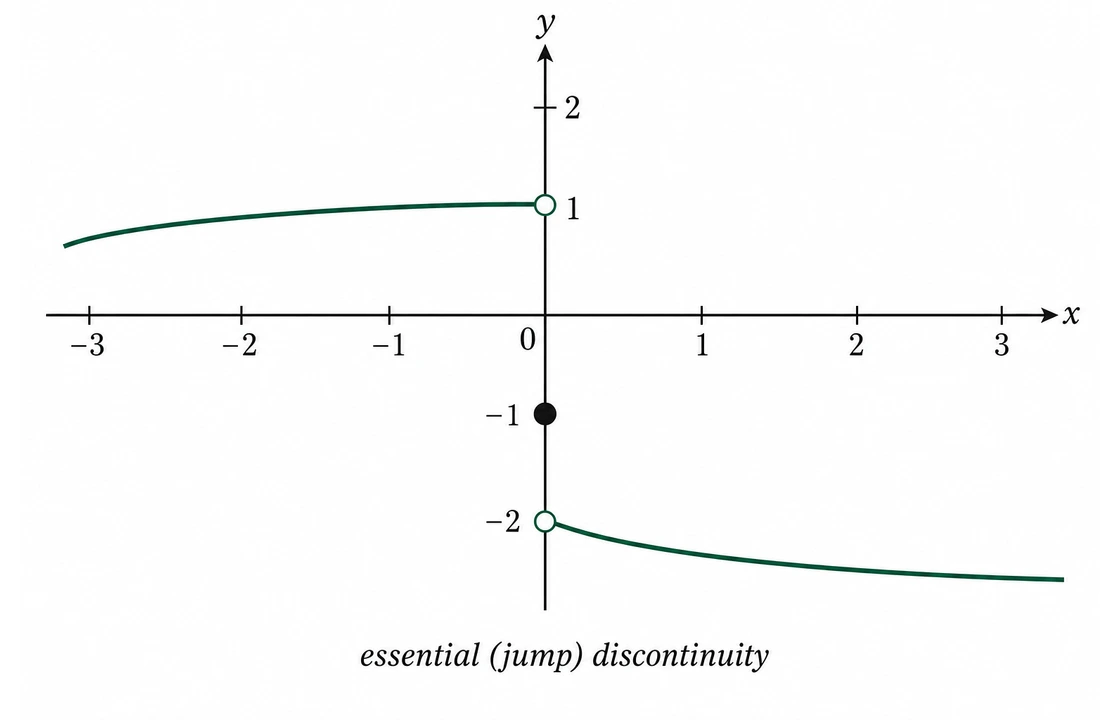
Any discontinuity that is not removable. That is, a place where a graph is not connected and cannot be made connected simply by filling in a single point. Step discontinuities and vertical asymptotes are two types of essential discontinuities.
Formally, an essential discontinuity is a discontinuity at which the limit of the function does not exist.
See also
Key Formula
x→climf(x) does not exist
Where:
- c = The point at which the function is discontinuous
- f(x) = The function being analyzed
Worked Example
Problem: Determine whether the function f(x) = 1/x has an essential discontinuity at x = 0.
Step 1: Evaluate the left-hand limit as x approaches 0 from the negative side.
x→0−limx1=−∞
Step 2: Evaluate the right-hand limit as x approaches 0 from the positive side.
x→0+limx1=+∞
Step 3: Compare the one-sided limits. Since one diverges to negative infinity and the other to positive infinity, the two-sided limit does not exist.
x→0limx1 does not exist
Step 4: Since the limit does not exist at x = 0, and you cannot fix the discontinuity by defining f(0) to be a single value, this is an essential discontinuity. Specifically, it is an infinite discontinuity (vertical asymptote).
Answer: f(x) = 1/x has an essential discontinuity (vertical asymptote) at x = 0.
Another Example
This example illustrates a jump discontinuity rather than the infinite discontinuity shown in the first example. It also shows how to distinguish a continuous piecewise function from one with an essential discontinuity.
Problem: Determine the type of discontinuity for the piecewise function g(x) = { 2x + 1 if x < 3, and 4x − 5 if x ≥ 3 } at x = 3.
Step 1: Evaluate the left-hand limit as x approaches 3 from below, using the first piece.
x→3−lim(2x+1)=2(3)+1=7
Step 2: Evaluate the right-hand limit as x approaches 3 from above, using the second piece.
x→3+lim(4x−5)=4(3)−5=7
Step 3: Both one-sided limits equal 7, so the two-sided limit exists and equals 7.
x→3limg(x)=7
Step 4: Check the function value: g(3) = 4(3) − 5 = 7. Since the limit equals the function value, g is actually continuous at x = 3. There is no discontinuity here — neither essential nor removable.
g(3)=7=x→3limg(x)
Step 5: Now change the problem slightly: suppose h(x) = { 2x + 1 if x < 3, and 4x if x ≥ 3 }. Then the left-hand limit is still 7, but the right-hand limit is 4(3) = 12. Since the one-sided limits differ, the two-sided limit does not exist, so x = 3 is an essential (jump/step) discontinuity.
x→3−limh(x)=7=12=x→3+limh(x)
Answer: The modified function h(x) has a jump (step) discontinuity at x = 3, which is an essential discontinuity because the left-hand and right-hand limits are not equal.
Frequently Asked Questions
What is the difference between a removable discontinuity and an essential discontinuity?
A removable discontinuity occurs where the limit of f(x) exists but does not equal the function's value (or the function is undefined). You can 'remove' it by redefining f at that single point. An essential discontinuity occurs where the limit itself does not exist — either because the one-sided limits differ (jump discontinuity) or because the function diverges to infinity (infinite discontinuity). No single-point redefinition can fix it.
How do you tell if a discontinuity is essential?
Compute the left-hand limit and the right-hand limit at the point in question. If either one-sided limit does not exist (diverges to infinity, oscillates, etc.) or if both exist but are not equal, then the two-sided limit does not exist and the discontinuity is essential. If both one-sided limits exist and are equal, the discontinuity is removable, not essential.
Is a vertical asymptote always an essential discontinuity?
Yes. At a vertical asymptote, the function values grow without bound (toward positive or negative infinity), so the limit does not exist as a finite number. Since the limit fails to exist, the discontinuity cannot be removed by filling in a single point, making it essential by definition.
Essential Discontinuity vs. Removable Discontinuity
| Essential Discontinuity | Removable Discontinuity | |
|---|---|---|
| Limit behavior | The limit at the point does not exist | The limit at the point exists (finite value) |
| Can it be fixed? | Cannot be made continuous by redefining f at a single point | Can be made continuous by redefining f at that one point |
| Subtypes | Jump (step) discontinuity, infinite discontinuity (vertical asymptote), oscillating discontinuity | Hole in the graph (point discontinuity) |
| Example | f(x) = 1/x at x = 0 | f(x) = (x² − 4)/(x − 2) at x = 2 |
| Graph appearance | A jump between two branches, or a curve shooting off to infinity | A single hole (missing dot) in an otherwise smooth curve |
Why It Matters
Essential discontinuities appear frequently in calculus when you study limits, continuity, and integrability. Recognizing whether a discontinuity is removable or essential determines how you can evaluate limits and whether certain theorems (like the Intermediate Value Theorem) apply. In physics and engineering, essential discontinuities model real phenomena such as sudden voltage changes (step functions) and singularities in force fields (inverse-square laws).
Common Mistakes
Mistake: Confusing a hole in the graph (removable discontinuity) with a jump or asymptote (essential discontinuity).
Correction: Always check whether the two-sided limit exists. If the limit exists but does not match the function value, it is removable. If the limit does not exist at all, it is essential.
Mistake: Assuming that if a function is undefined at a point, it automatically has an essential discontinuity there.
Correction: A function can be undefined at a point and still have only a removable discontinuity. For example, f(x) = (x² − 9)/(x − 3) is undefined at x = 3, but the limit is 6, so the discontinuity is removable, not essential.
Related Terms
- Discontinuity — General concept that includes essential discontinuities
- Removable Discontinuity — The other main type — limit exists, unlike essential
- Step Discontinuity — A subtype of essential discontinuity (jump)
- Asymptote — Vertical asymptotes produce infinite essential discontinuities
- Limit — Key tool for classifying discontinuities
- Continuous Function — A function with no discontinuities of any type
- Function — The object being analyzed for discontinuities
- Point — Discontinuities occur at specific points