Mathwords logoReference LibraryMathwords

Deleted Neighborhood

Deleted Neighborhood

The proper name for a set such as {x: 0 < |xa| < δ}. Deleted neighborhoods are encountered in the study of limits. It is the set of all numbers less than δ units away from a, omitting the number a itself.

Using interval notation the set {x: 0 < |xa| < δ} would be (a – δ, a) ∪ (a, a + δ). In general, a deleted neighborhood of a is any set (c, a) ∪ (a, d) where c < a < d.

For example, one deleted neighborhood of 2 is the set {x: 0 < |x – 2| < 0.1}, which is the same as (1.9, 2) ∪ (2, 2.1).
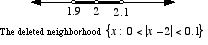
 

Number line showing deleted neighborhood {x: 0 < |x−2| < 0.1} with points 1.9, 2, and 2.1 marked, open circle at 2.


See also

Neighborhood, set-builder notation, interval notation

Key Formula

{x:0<xa<δ}=(aδ,  a)(a,  a+δ)\{x : 0 < |x - a| < \delta\} = (a - \delta,\; a) \cup (a,\; a + \delta)
Where:
  • aa = The center point that is excluded from the neighborhood
  • δ\delta = A positive number giving the radius of the neighborhood
  • xx = Any real number in the set (must satisfy both inequalities)

Worked Example

Problem: Write the deleted neighborhood of a=5a = 5 with radius δ=0.3\delta = 0.3 in set-builder notation and in interval notation. Then determine whether x=5x = 5 and x=5.2x = 5.2 belong to this set.
Step 1: Write the set-builder form by substituting a=5a = 5 and δ=0.3\delta = 0.3.
{x:0<x5<0.3}\{x : 0 < |x - 5| < 0.3\}
Step 2: Convert to interval notation. The neighborhood spans from 50.3=4.75 - 0.3 = 4.7 to 5+0.3=5.35 + 0.3 = 5.3, but excludes the center point 55.
(4.7,  5)(5,  5.3)(4.7,\; 5) \cup (5,\; 5.3)
Step 3: Check x=5x = 5. Compute 55=0|5 - 5| = 0. The condition 0<00 < 0 is false, so x=5x = 5 is NOT in the set.
55=0    0<0 is false|5 - 5| = 0 \;\Rightarrow\; 0 < 0 \text{ is false}
Step 4: Check x=5.2x = 5.2. Compute 5.25=0.2|5.2 - 5| = 0.2. Since 0<0.2<0.30 < 0.2 < 0.3, the point x=5.2x = 5.2 IS in the deleted neighborhood.
5.25=0.2    0<0.2<0.3  |5.2 - 5| = 0.2 \;\Rightarrow\; 0 < 0.2 < 0.3 \;\checkmark
Answer: The deleted neighborhood is (4.7,5)(5,5.3)(4.7, 5) \cup (5, 5.3). The point x=5x = 5 is excluded; the point x=5.2x = 5.2 is included.

Another Example

This example shows a deleted neighborhood in its most common real-world context: the epsilon-delta definition of a limit. It illustrates WHY the center point must be excluded.

Problem: In the epsilon-delta definition of limx3(2x+1)=7\lim_{x \to 3} (2x + 1) = 7, identify the deleted neighborhood used when δ=0.5\delta = 0.5, and explain its role.
Step 1: The limit definition says: for every ε>0\varepsilon > 0, there exists δ>0\delta > 0 such that whenever 0<x3<δ0 < |x - 3| < \delta, we have f(x)7<ε|f(x) - 7| < \varepsilon. The condition 0<x3<δ0 < |x - 3| < \delta defines a deleted neighborhood of 33.
0<x3<0.50 < |x - 3| < 0.5
Step 2: Convert this deleted neighborhood to interval notation.
(2.5,  3)(3,  3.5)(2.5,\; 3) \cup (3,\; 3.5)
Step 3: Notice that x=3x = 3 itself is excluded. This is essential because the limit describes the behavior of f(x)f(x) as xx approaches 33, not the value at 33. The function does not even need to be defined at x=3x = 3 for the limit to exist.
Limit requires x3\text{Limit requires } x \neq 3
Step 4: For any xx in this deleted neighborhood, compute how close f(x)f(x) is to 77: f(x)7=2x+17=2x6=2x3<2(0.5)=1|f(x) - 7| = |2x + 1 - 7| = |2x - 6| = 2|x - 3| < 2(0.5) = 1. So choosing δ=0.5\delta = 0.5 guarantees f(x)7<1|f(x) - 7| < 1, which means ε=1\varepsilon = 1 works.
f(x)7=2x3<2(0.5)=1|f(x) - 7| = 2|x - 3| < 2(0.5) = 1
Answer: The deleted neighborhood is (2.5,3)(3,3.5)(2.5, 3) \cup (3, 3.5). It ensures we examine f(x)f(x) near x=3x = 3 without evaluating at x=3x = 3 itself, which is exactly what the limit definition requires.

Frequently Asked Questions

What is the difference between a neighborhood and a deleted neighborhood?
A neighborhood of aa with radius δ\delta is the open interval (aδ,a+δ)(a - \delta, a + \delta), which includes the point aa. A deleted neighborhood is the same interval with aa removed: (aδ,a)(a,a+δ)(a - \delta, a) \cup (a, a + \delta). The only difference is whether the center point is present. The word 'deleted' refers specifically to removing that center point.
Why does the limit definition use a deleted neighborhood instead of a regular neighborhood?
The limit limxaf(x)=L\lim_{x \to a} f(x) = L describes what f(x)f(x) approaches as xx gets close to aa, not what happens at aa. The function might not even be defined at aa (think of sinxx\frac{\sin x}{x} at x=0x = 0). By using a deleted neighborhood—requiring 0<xa0 < |x - a|—the definition deliberately ignores the value at aa and focuses only on nearby points.
How do you write a deleted neighborhood in interval notation?
You split it into two open intervals joined by a union. The deleted neighborhood {x:0<xa<δ}\{x : 0 < |x - a| < \delta\} becomes (aδ,a)(a,a+δ)(a - \delta, a) \cup (a, a + \delta). The gap at aa between the two intervals is what makes it 'deleted.'

Deleted Neighborhood vs. Neighborhood

Deleted NeighborhoodNeighborhood
DefinitionAll points within distance δ of a, excluding a itselfAll points within distance δ of a, including a
Set-builder notation{x:0<xa<δ}\{x : 0 < |x - a| < \delta\}{x:xa<δ}\{x : |x - a| < \delta\}
Interval notation(aδ,a)(a,a+δ)(a - \delta, a) \cup (a, a + \delta)(aδ,a+δ)(a - \delta, a + \delta)
Contains center point a?NoYes
Primary useEpsilon-delta definition of limitsContinuity, open set definitions

Why It Matters

Deleted neighborhoods are central to the formal (epsilon-delta) definition of a limit, which you encounter in precalculus and early calculus courses. Understanding why the center point is excluded helps you grasp why limits can exist even when a function is undefined or has a different value at that point. This concept also reappears when studying removable discontinuities and improper integrals.

Common Mistakes

Mistake: Including the center point aa in the deleted neighborhood.
Correction: The strict inequality 0<xa0 < |x - a| means xax \neq a. If you allow xa=0|x - a| = 0, you have an ordinary neighborhood, not a deleted one. Always check that the lower bound is strictly greater than zero.
Mistake: Writing the deleted neighborhood as a single interval (aδ,a+δ)(a - \delta, a + \delta).
Correction: A single open interval includes aa. You must write it as two separate intervals joined by a union: (aδ,a)(a,a+δ)(a - \delta, a) \cup (a, a + \delta). The gap at aa is the entire point of the concept.

Related Terms