Mean Value Theorem — Definition, Formula & Examples
Mean Value Theorem
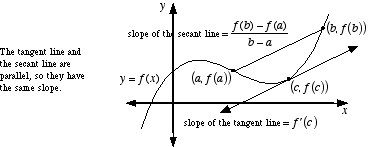
A major theorem of calculus that relates values of a function to a value of its derivative. Essentially the theorem states that for a "nice" function, there is a tangent line parallel to any secant line.
![Mean Value Theorem: if f is continuous on [a,b] and differentiable on (a,b), then f'(c) = (f(b) - f(a)) / (b - a)](/m/m_assets/m21.gif)

See also
Mean value theorem for integrals, continuous, differentiable, slope, Rolle's theorem
Key Formula
f′(c)=b−af(b)−f(a)
Where:
- f = A function that is continuous on [a, b] and differentiable on (a, b)
- a = The left endpoint of the closed interval
- b = The right endpoint of the closed interval
- c = A value in the open interval (a, b) where the derivative equals the average rate of change
- f′(c) = The derivative of f evaluated at c (the slope of the tangent line at c)
- b−af(b)−f(a) = The average rate of change of f over [a, b] (the slope of the secant line)
Worked Example
Problem: Let f(x) = x² on the interval [1, 3]. Find the value of c guaranteed by the Mean Value Theorem.
Step 1: Verify the hypotheses. f(x) = x² is a polynomial, so it is continuous on [1, 3] and differentiable on (1, 3). The Mean Value Theorem applies.
Step 2: Compute the average rate of change (the slope of the secant line) over [1, 3].
3−1f(3)−f(1)=29−1=28=4
Step 3: Find the derivative of f.
f′(x)=2x
Step 4: Set the derivative equal to the average rate of change and solve for c.
2c=4⟹c=2
Step 5: Confirm that c = 2 lies in the open interval (1, 3). It does, so the theorem is satisfied.
Answer: c = 2. At x = 2, the tangent line to f(x) = x² has slope 4, which equals the slope of the secant line from (1, 1) to (3, 9).
Another Example
This example differs from the first because it uses a cubic function, and the quadratic equation for c produces two roots — only one of which lies in the given interval. This illustrates that you must always check whether each solution for c falls inside (a, b).
Problem: Let f(x) = x³ − 3x on the interval [0, 2]. Find all values of c in (0, 2) guaranteed by the Mean Value Theorem.
Step 1: Check hypotheses. f(x) = x³ − 3x is a polynomial, so it is continuous on [0, 2] and differentiable on (0, 2).
Step 2: Compute the average rate of change over [0, 2].
2−0f(2)−f(0)=2(8−6)−0=22=1
Step 3: Find the derivative of f.
f′(x)=3x2−3
Step 4: Set the derivative equal to 1 and solve for c.
3c2−3=1⟹3c2=4⟹c2=34⟹c=±32
Step 5: Keep only values in (0, 2). Since 2/√3 ≈ 1.155, which lies in (0, 2), this is valid. The negative root is not in the interval.
c=32=323≈1.155
Answer: c = 2√3 / 3 ≈ 1.155. At this point, the instantaneous rate of change equals the average rate of change of 1.
Frequently Asked Questions
What is the difference between the Mean Value Theorem and Rolle's Theorem?
Rolle's Theorem is a special case of the Mean Value Theorem where f(a) = f(b). In that case, the average rate of change is zero, so the theorem guarantees a point c where f'(c) = 0. The Mean Value Theorem generalizes this by dropping the requirement that the endpoint values be equal, guaranteeing instead that f'(c) equals the (possibly nonzero) average rate of change.
When does the Mean Value Theorem not apply?
The theorem does not apply if the function fails to be continuous on the closed interval [a, b] or fails to be differentiable on the open interval (a, b). A classic example is f(x) = |x| on [−1, 1]: the function is continuous but not differentiable at x = 0, and indeed no value of c satisfies the conclusion. Functions with jumps, holes, or sharp corners can violate the hypotheses.
What does the Mean Value Theorem actually tell you in real life?
It says that at some instant during a journey, your instantaneous speed must equal your average speed. For example, if you drive 120 miles in 2 hours, your average speed is 60 mph, and the MVT guarantees there was at least one moment when your speedometer read exactly 60 mph. This principle is also used in proofs throughout calculus, such as showing that a function with zero derivative everywhere on an interval must be constant.
Mean Value Theorem vs. Rolle's Theorem
| Mean Value Theorem | Rolle's Theorem | |
|---|---|---|
| Hypotheses | f continuous on [a, b], differentiable on (a, b) | Same as MVT, plus f(a) = f(b) |
| Conclusion | There exists c in (a, b) with f'(c) = (f(b) − f(a))/(b − a) | There exists c in (a, b) with f'(c) = 0 |
| Geometric meaning | Tangent line parallel to the secant line through endpoints | Horizontal tangent line exists between endpoints at the same height |
| Relationship | The general theorem | A special case of the MVT |
Why It Matters
The Mean Value Theorem appears throughout AP Calculus (AB and BC) and university-level analysis courses. It is used to prove many other results, including that functions with positive derivatives are increasing and that two antiderivatives of the same function differ by a constant. Beyond exams, the theorem underlies error estimation, optimization arguments, and the formal justification of techniques you rely on daily in calculus.
Common Mistakes
Mistake: Forgetting to verify the hypotheses before applying the theorem.
Correction: Always check that f is continuous on the closed interval [a, b] AND differentiable on the open interval (a, b). If either condition fails — for instance at a cusp, corner, or discontinuity — the theorem's conclusion is not guaranteed.
Mistake: Assuming the theorem gives exactly one value of c.
Correction: The MVT guarantees at least one c, but there may be more than one. After solving f'(c) = (f(b) − f(a))/(b − a), keep all solutions that lie in (a, b). Discard only those outside the interval.
Related Terms
- Rolle's Theorem — Special case where f(a) = f(b)
- Derivative — The instantaneous rate of change used in the theorem
- Tangent Line — Line whose slope equals f'(c)
- Secant Line — Line through endpoints whose slope equals the average rate
- Continuous Function — Required hypothesis for the theorem
- Differentiable — Required hypothesis on the open interval
- Mean Value Theorem for Integrals — Analogous theorem for definite integrals
- Slope of a Line — Both sides of the MVT equation represent slopes