
Dilation of a Geometric Figure — Definition & Examples
Dilation of a Geometric Figure
A transformation in which all distances are lengthened by a common factor. This is done by stretching all points away from some fixed point P.
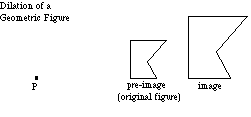
See also
Dilation, dilation of a graph, compression of a geometric figure, pre-image, image
Key Formula
(x′,y′)=(k(x−a)+a,k(y−b)+b)
Where:
- (x,y) = Coordinates of any point on the original figure (pre-image)
- (x′,y′) = Coordinates of the corresponding point on the dilated figure (image)
- (a,b) = Coordinates of the center of dilation (the fixed point P)
- k = Scale factor — the ratio by which all distances from the center are multiplied
Worked Example
Problem: Triangle ABC has vertices A(1, 2), B(5, 2), and C(3, 6). Dilate the triangle by a scale factor of 2 with the center of dilation at the origin (0, 0).
Step 1: Write the dilation formula with center (0, 0) and scale factor k = 2. Since the center is the origin, the formula simplifies.
(x′,y′)=(2x,2y)
Step 2: Apply the formula to vertex A(1, 2).
A′=(2⋅1,2⋅2)=(2,4)
Step 3: Apply the formula to vertex B(5, 2).
B′=(2⋅5,2⋅2)=(10,4)
Step 4: Apply the formula to vertex C(3, 6).
C′=(2⋅3,2⋅6)=(6,12)
Step 5: Verify that the side lengths doubled. Original AB = 4 units; new A'B' = 8 units. The shape is preserved but the figure is twice as large.
AB=5−1=4,A′B′=10−2=8=2×4✓
Answer: The dilated triangle has vertices A'(2, 4), B'(10, 4), and C'(6, 12).
Another Example
This example uses a non-origin center of dilation and a fractional scale factor (k < 1), which produces a reduction rather than an enlargement.
Problem: A square has vertices P(2, 3), Q(6, 3), R(6, 7), and S(2, 7). Dilate the square by a scale factor of 1/2 with the center of dilation at (4, 5).
Step 1: Write the dilation formula using center (a, b) = (4, 5) and k = 1/2.
(x′,y′)=(21(x−4)+4,21(y−5)+5)
Step 2: Apply to vertex P(2, 3).
P′=(21(2−4)+4,21(3−5)+5)=(3,4)
Step 3: Apply to vertex Q(6, 3).
Q′=(21(6−4)+4,21(3−5)+5)=(5,4)
Step 4: Apply to vertices R(6, 7) and S(2, 7).
R′=(5,6),S′=(3,6)
Step 5: Check the result. The original side length was 4 units; the new side length is 2 units. The center (4, 5) stays fixed, and the figure shrinks toward it.
P′Q′=5−3=2=21×4✓
Answer: The dilated square has vertices P'(3, 4), Q'(5, 4), R'(5, 6), and S'(3, 6).
Frequently Asked Questions
What is the difference between dilation and translation?
A dilation changes the size of a figure while keeping its shape, using a scale factor and a center point. A translation slides every point of a figure the same distance in the same direction without changing its size or shape at all. Dilation produces a similar figure; translation produces a congruent figure.
What happens when the scale factor of a dilation is less than 1?
When the scale factor k is between 0 and 1, the image is smaller than the original — this is called a reduction or compression. Every point moves closer to the center of dilation. For example, a scale factor of 1/3 shrinks all distances from the center to one-third of their original length.
Does dilation preserve angle measures and shape?
Yes. Dilation preserves all angle measures and the overall shape of a figure. Corresponding sides of the pre-image and image are proportional, so the two figures are similar. Dilation does not generally preserve side lengths or area unless the scale factor is 1.
Dilation of a Geometric Figure vs. Compression of a Geometric Figure
| Dilation of a Geometric Figure | Compression of a Geometric Figure | |
|---|---|---|
| Definition | Transformation that stretches a figure away from a center point | Transformation that shrinks a figure toward a center point |
| Scale factor | k > 1 (figure gets larger) | 0 < k < 1 (figure gets smaller) |
| Effect on distances | All distances from the center are multiplied by a factor greater than 1 | All distances from the center are multiplied by a factor less than 1 |
| Shape preserved? | Yes — produces a similar figure | Yes — produces a similar figure |
| Formula | (x', y') = (k(x−a)+a, k(y−b)+b) with k > 1 | Same formula but with 0 < k < 1 |
Why It Matters
Dilation appears throughout geometry courses when you study similarity, scale drawings, and coordinate transformations. Standardized tests frequently ask you to find the image of a figure after dilation or to determine the scale factor between two similar shapes. In real life, dilation describes how maps, blueprints, and photo enlargements work — all of which scale distances by a constant factor from a reference point.
Common Mistakes
Mistake: Multiplying the original coordinates directly by the scale factor when the center of dilation is not the origin.
Correction: You must first subtract the center coordinates, then multiply by k, then add the center coordinates back. The formula is (x', y') = (k(x − a) + a, k(y − b) + b). Only when the center is (0, 0) does this simplify to (kx, ky).
Mistake: Thinking that a scale factor less than 1 makes the figure negative or flipped.
Correction: A scale factor between 0 and 1 simply produces a smaller figure (a compression). The figure only reflects through the center when the scale factor is negative. A positive fractional k just reduces the size.
Related Terms
- Transformations — Dilation is one of the four main transformations
- Dilation — General concept covering all dilation types
- Dilation of a Graph — Applies dilation to function graphs instead of figures
- Compression of a Geometric Figure — A dilation with scale factor between 0 and 1
- Pre-Image of a Transformation — The original figure before dilation is applied
- Image of a Transformation — The resulting figure after dilation is applied
- Point — The center of dilation is a fixed point
- Fixed — The center of dilation remains fixed (unmoved)