
Descartes' Rule of Signs — Definition & Examples
Descartes' Rule of Signs
A method for determining the maximum number of positive zeros for a polynomial. This maximum is the number of sign changes in the polynomial when written as shown below.
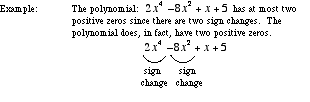
Worked Example
Problem: Use Descartes' Rule of Signs to determine the possible number of positive and negative real zeros of f(x) = 2x⁴ − x³ − 3x² + 5x − 1.
Step 1: Write out the signs of each coefficient in order for f(x).
f(x)=+2x4−−x3−−3x2++5x−−1
Step 2: Count the sign changes between consecutive terms: (+) to (−) is one change, (−) to (−) is no change, (−) to (+) is one change, (+) to (−) is one change. That gives 3 sign changes.
+→−→−→+→−⇒3 sign changes
Step 3: By Descartes' Rule, the number of positive real zeros is 3, or 3 minus an even number (i.e., 3 or 1).
Positive real zeros: 3 or 1
Step 4: Now substitute −x into the polynomial to analyze negative real zeros.
f(−x)=2(−x)4−(−x)3−3(−x)2+5(−x)−1=2x4+x3−3x2−5x−1
Step 5: Count the sign changes in f(−x): (+) to (+) is no change, (+) to (−) is one change, (−) to (−) is no change, (−) to (−) is no change. That gives 1 sign change.
+→+→−→−→−⇒1 sign change
Step 6: So the number of negative real zeros is exactly 1 (since 1 minus an even number can only be 1).
Negative real zeros: 1
Answer: The polynomial f(x) = 2x⁴ − x³ − 3x² + 5x − 1 has either 3 or 1 positive real zeros and exactly 1 negative real zero.
Another Example
Problem: Use Descartes' Rule of Signs to find the possible number of positive and negative real zeros of g(x) = x³ + 2x² + x + 6.
Step 1: List the signs of the coefficients: all are positive.
g(x)=+x3+2x2+x+6⇒+,+,+,+
Step 2: There are 0 sign changes, so there are 0 positive real zeros.
Positive real zeros: 0
Step 3: Substitute −x to check for negative real zeros.
g(−x)=−x3+2x2−x+6⇒−,+,−,+
Step 4: Count sign changes: (−) to (+) is one, (+) to (−) is two, (−) to (+) is three. There are 3 sign changes.
Negative real zeros: 3 or 1
Answer: g(x) has 0 positive real zeros and either 3 or 1 negative real zeros. Since it is a degree-3 polynomial, the remaining zeros (if any) must be non-real complex numbers.
Frequently Asked Questions
Why do you subtract 2 (an even number) each time?
Complex (non-real) roots of polynomials with real coefficients always come in conjugate pairs. Each missing pair of real zeros is replaced by exactly two complex zeros. That is why the actual count of positive (or negative) real zeros drops by 2 at a time from the maximum given by the sign changes.
Does Descartes' Rule tell you the exact number of real zeros?
No. It gives you the maximum number and all lesser possibilities that differ by 2. To find the exact count, you typically need additional tools like graphing, the Rational Root Theorem, or synthetic division.
Descartes' Rule of Signs vs. Rational Root Theorem
Descartes' Rule tells you how many positive or negative real zeros are possible, but not what those zeros are. The Rational Root Theorem gives you a list of specific rational numbers to test as potential zeros. The two methods are often used together: Descartes' Rule narrows down how many zeros to expect, and the Rational Root Theorem suggests candidates to check.
Why It Matters
Descartes' Rule of Signs gives you a quick preview of a polynomial's behavior before you start the harder work of finding exact roots. It helps you avoid wasted effort — if the rule says there are zero positive real roots, you know not to bother testing positive values. This makes it a valuable first step when solving or graphing higher-degree polynomials.
Common Mistakes
Mistake: Counting sign changes using only the terms that appear, while forgetting that missing terms (zero coefficients) do not contribute a sign change.
Correction: Skip any term with a zero coefficient entirely. A zero coefficient has no sign, so compare the signs of the nearest non-zero coefficients on either side.
Mistake: Thinking the number of sign changes is the exact count of positive (or negative) zeros.
Correction: The sign-change count is the maximum. The actual number could be any value less than that maximum by a multiple of 2. For example, 4 sign changes means 4, 2, or 0 positive real zeros.
Related Terms
- Polynomial — The type of function the rule applies to
- Zero of a Function — What the rule helps you count
- Positive Number — Positive zeros are one category analyzed
- Rational Root Theorem — Lists specific candidates for rational zeros
- Synthetic Division — Used to test and verify potential zeros