Numbers written in any of the ways shown below. Each notation
is read aloud "n choose r".
These numbers, called binomial
coefficients because they are used in the binomial
theorem, refer to specific addresses in Pascal's
triangle.
They refer to the nth row, rth element
in Pascal's triangle as shown below.
The formula used to compute binomial
coefficients directly is found below as well.
Example:
is
the 5th row, 4th element, so
5C4 is
another notation for the same element.
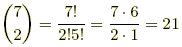
Formula:
Examples:
Key Formula
(rn)=r!(n−r)!n!
Where:
n = The row number in Pascal's triangle (starting from row 0), or equivalently the total number of items to choose from
r = The position within that row (starting from element 0), or equivalently the number of items being chosen
! = Factorial — the product of all positive integers up to that number (e.g., 4! = 4 × 3 × 2 × 1 = 24)
Worked Example
Problem:Find the value of the binomial coefficient (26) using the formula, and verify its location in Pascal's triangle.
Step 1: Identify n and r. Here n = 6 and r = 2, so you are looking at row 6, element 2 of Pascal's triangle.
(26)=2!(6−2)!6!
Step 2: Compute each factorial. Calculate 6!, 2!, and 4!.
6!=720,2!=2,4!=24
Step 3: Substitute the factorial values into the formula.
(26)=2×24720=48720
Step 4: Divide to get the final value.
(26)=15
Step 5: Verify: Row 6 of Pascal's triangle is 1, 6, 15, 20, 15, 6, 1. The element at position 2 (counting from 0) is indeed 15.
Answer:(26)=15
Another Example
This example uses Pascal's rule (the addition property) instead of computing (37) directly from the factorial formula. It shows how entries in Pascal's triangle are built from the row above.
Problem:Use Pascal's triangle's addition property to find (37) without computing large factorials.
Step 1: Apply Pascal's rule, which states that each entry is the sum of the two entries directly above it.
(37)=(26)+(36)
Step 2:Find (26). From the first example, this equals 15.
(26)=15
Step 3:Find (36) using the formula.
(36)=3!3!6!=6×6720=36720=20
Step 4: Add the two values together.
(37)=15+20=35
Answer:(37)=35
Frequently Asked Questions
What is the relationship between binomial coefficients and Pascal's triangle?
Every number in Pascal's triangle is a binomial coefficient. The entry in row n, position r (both starting from 0) equals (rn). Pascal's triangle simply arranges all binomial coefficients into a triangular grid, where each entry is the sum of the two entries directly above it.
Why are they called binomial coefficients?
They are called binomial coefficients because they appear as the coefficients when you expand a binomial (a two-term expression) raised to a power. For example, (a+b)4=1a4+4a3b+6a2b2+4ab3+1b4, and the coefficients 1, 4, 6, 4, 1 are exactly row 4 of Pascal's triangle: (04),(14),(24),(34),(44).
What do (0n) and (nn) always equal?
Both (0n) and (nn) always equal 1. This is why every row of Pascal's triangle starts and ends with 1. There is exactly one way to choose nothing from n items, and exactly one way to choose all n items.
Binomial Coefficient (formula) vs. Pascal's Triangle (visual method)
Binomial Coefficient (formula)
Pascal's Triangle (visual method)
How you compute
Use the formula n! / (r!(n−r)!)
Build the triangle row by row, adding pairs of adjacent entries
Best for
Finding a single specific value, especially for large n
Finding an entire row of coefficients at once, or spotting patterns
Key advantage
Direct calculation — no need to build previous rows
Only requires addition — no multiplication or factorials needed
Notation
(rn), nCr, or C(n,r)
Numbers arranged in a triangular array
Why It Matters
Binomial coefficients appear throughout algebra and probability. When you expand (x+y)n using the binomial theorem, the coefficients come directly from the nth row of Pascal's triangle. In probability and statistics, (rn) counts the number of combinations — for instance, how many ways to choose a committee of 3 from 10 people — making it essential for calculating binomial probabilities and solving counting problems.
Common Mistakes
Mistake: Starting the row and element count at 1 instead of 0.
Correction:Pascal's triangle rows and positions both start at 0. Row 0 is the single "1" at the top. So (25) is in row 5 (the sixth row from the top) at position 2 (the third entry). Miscounting by one leads to the wrong value.
Mistake:Computing (rn) as r!n! and forgetting the (n−r)! in the denominator.
Correction:The full formula is r!(n−r)!n!. Leaving out (n−r)! gives the number of permutations nPr, not the number of combinations. Combinations do not care about order, so you must divide by (n−r)! as well.



 is
the 5th row, 4th element, so
is
the 5th row, 4th element, so