
Circular Cylinder — Definition, Formula & Examples
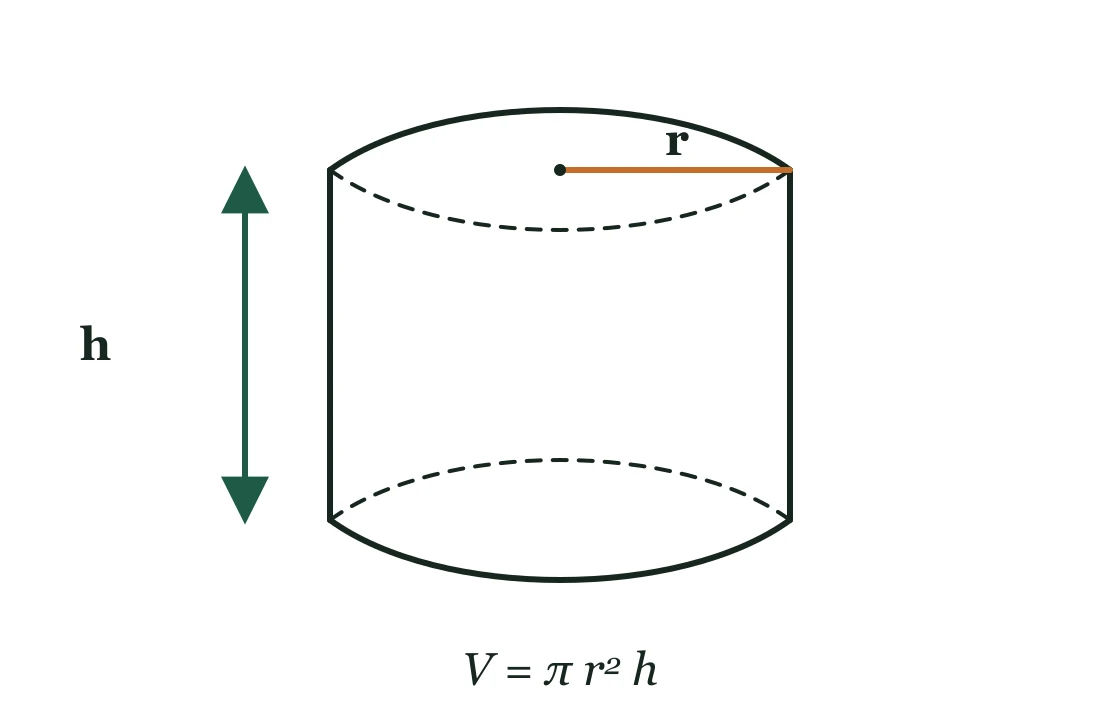
Key Formula
V=πr2handS=2πr2+2πrh
Where:
- V = Volume of the circular cylinder
- S = Total surface area of a right circular cylinder
- r = Radius of the circular base
- h = Height (perpendicular distance between the two bases)
- π = Pi, approximately 3.14159
Worked Example
Problem: Find the volume and total surface area of a right circular cylinder with radius 5 cm and height 12 cm.
Step 1: Write down the known values: radius r = 5 cm and height h = 12 cm.
r=5 cm,h=12 cm
Step 2: Calculate the volume using the formula V = πr²h.
V=π(5)2(12)=π⋅25⋅12=300π≈942.5 cm3
Step 3: Calculate the area of the two circular bases.
2πr2=2π(5)2=50π≈157.1 cm2
Step 4: Calculate the lateral (side) surface area.
2πrh=2π(5)(12)=120π≈376.99 cm2
Step 5: Add both parts to get the total surface area.
S=50π+120π=170π≈534.1 cm2
Answer: The volume is 300π ≈ 942.5 cm³ and the total surface area is 170π ≈ 534.1 cm².
Another Example
This example works backward from a known volume to find a missing dimension, which is a common problem type in geometry courses.
Problem: A circular cylinder has a volume of 500π cm³ and a height of 20 cm. Find the radius of its base.
Step 1: Write the volume formula and substitute the known values.
V=πr2h⟹500π=πr2(20)
Step 2: Divide both sides by π to simplify.
500=r2⋅20
Step 3: Solve for r² by dividing both sides by 20.
r2=20500=25
Step 4: Take the positive square root to find r.
r=25=5 cm
Answer: The radius of the base is 5 cm.
Frequently Asked Questions
What is the difference between a circular cylinder and a right circular cylinder?
A circular cylinder is any cylinder with circular bases — the axis connecting the centers of the two bases can be perpendicular or tilted relative to the bases. A right circular cylinder is the special case where the axis is perpendicular to both bases, so the side stands straight up. An oblique circular cylinder has a tilted axis, meaning it leans to one side.
Does the volume formula change for an oblique circular cylinder?
No. The volume formula V = πr²h works for both right and oblique circular cylinders, as long as h is the perpendicular height (the altitude) between the two bases, not the slant length. This follows from Cavalieri's principle, which states that solids with equal cross-sectional areas at every height have equal volumes.
How is a circular cylinder different from other types of cylinders?
A cylinder, in general, can have any closed curve as its base — for example, an ellipse produces an elliptical cylinder. A circular cylinder specifically requires both bases to be congruent circles. In most school-level geometry, when people say 'cylinder' they almost always mean a right circular cylinder.
Right Circular Cylinder vs. Oblique Circular Cylinder
| Right Circular Cylinder | Oblique Circular Cylinder | |
|---|---|---|
| Base shape | Circle | Circle |
| Axis orientation | Perpendicular to the bases | Tilted (not perpendicular to the bases) |
| Volume | V = πr²h | V = πr²h (same formula, h is the perpendicular height) |
| Lateral surface area | 2πrh (simple rectangle when unrolled) | More complex — not a simple rectangle when unrolled |
| Cross-section parallel to base | Circle of radius r | Circle of radius r |
| Common usage | Cans, pipes, most real-world cylinders | Leaning stacks, certain architectural columns |
Why It Matters
Circular cylinders appear constantly in geometry courses, standardized tests, and real-world applications. Cans, pipes, tanks, and columns are all modeled as circular cylinders, so calculating their volume and surface area is a practical skill. Understanding this shape also builds a foundation for calculus topics like solids of revolution and integration in cylindrical coordinates.
Common Mistakes
Mistake: Using the diameter instead of the radius in the formulas.
Correction: The formulas V = πr²h and S = 2πr² + 2πrh require the radius, not the diameter. If you are given the diameter d, divide by 2 first: r = d/2.
Mistake: Confusing height with slant height for oblique cylinders.
Correction: The height h in the volume formula is always the perpendicular distance between the two bases (the altitude), not the length of the slanted side. Using the slant length will give an incorrect, larger volume.
Related Terms
- Cylinder — General term; circular cylinder is a specific type
- Circle — Shape of both bases of the cylinder
- Base — The two parallel circular faces of the cylinder
- Right Circular Cylinder — Circular cylinder with axis perpendicular to bases
- Oblique Cylinder — Circular cylinder with a tilted axis
- Altitude of a Cylinder — Perpendicular height used in volume formula
- Volume — Key measurement calculated for cylinders
- Right Cylinder — Cylinder with axis perpendicular to any base shape