a = The left boundary of the interval on the x-axis
b = The right boundary of the interval on the x-axis
∣f(x)−g(x)∣ = The absolute value ensures the area is always positive, even if the curves swap positions
Worked Example
Problem: Find the area enclosed between y = x² and y = 2x from x = 0 to x = 2.
Step 1: Determine which function is on top. On the interval [0, 2], compare values: at x = 1, 2x = 2 and x² = 1, so y = 2x is above y = x².
2x≥x2 for 0≤x≤2
Step 2: Set up the integral with the top function minus the bottom function.
Area=∫02(2x−x2)dx
Step 3: Find the antiderivative of each term.
∫(2x−x2)dx=x2−3x3
Step 4: Evaluate the antiderivative at the bounds and subtract.
[x2−3x3]02=(4−38)−(0)=312−8=34
Answer: The area between the curves is 4/3 square units.
Another Example
This example shows what happens when the curves cross within the interval, requiring you to split the integral at the intersection point. Failing to split would give an answer of 0 because the positive and negative regions cancel.
Problem: Find the area enclosed between y = x³ and y = x on the interval from x = −1 to x = 1.
Step 1: Determine where the curves intersect and which is on top. Set x³ = x, giving x(x² − 1) = 0, so x = −1, 0, 1. On (−1, 0), test x = −0.5: x³ = −0.125 and x = −0.5, so x³ > x. On (0, 1), test x = 0.5: x³ = 0.125 and x = 0.5, so x > x³. The top curve switches at x = 0.
x3=x⟹x=−1,0,1
Step 2: Because the curves swap positions, split the integral into two parts.
Area=∫−10(x3−x)dx+∫01(x−x3)dx
Step 3: Evaluate the first integral.
∫−10(x3−x)dx=[4x4−2x2]−10=(0)−(41−21)=41
Step 4: Evaluate the second integral.
∫01(x−x3)dx=[2x2−4x4]01=21−41=41
Step 5: Add the two areas together.
Area=41+41=21
Answer: The area between the curves is 1/2 square unit.
Frequently Asked Questions
What is the difference between the area under a curve and the area between two curves?
The area under a curve measures the region between a single function and the x-axis, computed as ∫f(x) dx. The area between two curves measures the region between two functions, computed as ∫|f(x) − g(x)| dx. If one of the curves is the x-axis (y = 0), the two calculations are equivalent.
When should you integrate with respect to y instead of x?
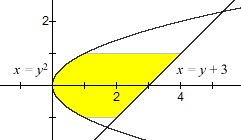
Integrate with respect to y when the bounding curves are more naturally expressed as functions of y, such as x = y² or x = y + 3. This is also useful when integrating with respect to x would force you to split the region into multiple integrals but integrating with respect to y does not.
Why do you need the absolute value in the area between curves formula?
The absolute value ensures the result is always positive. If f(x) dips below g(x) on part of the interval, the difference f(x) − g(x) becomes negative. Without absolute value, those negative portions would subtract from the total, giving an incorrect (or even zero) result. In practice, you handle this by identifying which function is on top in each sub-interval and subtracting accordingly.
Area between Curves vs. Area under a Curve
Area between Curves
Area under a Curve
Definition
Region enclosed between two functions
Region between one function and the x-axis
Formula
∫ₐᵇ |f(x) − g(x)| dx
∫ₐᵇ f(x) dx
Number of functions
Two (or more, handled pairwise)
One
When to use
Finding the enclosed region between two curves
Finding the total area between a curve and the horizontal axis
Special case
Reduces to area under a curve when g(x) = 0
Special case of the area between curves
Why It Matters
Area between curves is one of the most tested applications of definite integrals in AP Calculus AB/BC, college Calculus I, and the IB Mathematics curriculum. Beyond exams, it is used in physics to compute work done between force curves, in economics to find consumer and producer surplus, and in statistics to compare probability distributions.
Common Mistakes
Mistake: Forgetting to split the integral when the curves cross within the interval.
Correction: Always find intersection points first. If f(x) and g(x) swap which is on top, split the integral at each crossing and take the absolute value of each piece. Otherwise, positive and negative areas cancel, giving the wrong result.
Mistake: Subtracting in the wrong order (bottom minus top) and getting a negative area.
Correction: Always subtract the lower function from the upper function on each sub-interval. If you are unsure which is on top, plug in a test point from the interval. Alternatively, use the absolute value form to guarantee a positive result.