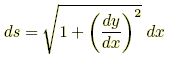
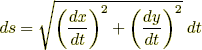
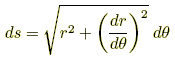
L=∫abdsRectangular (integrating over x):ds=1+(dxdy)2dxRectangular (integrating over y):ds=1+(dydx)2dyParametric:ds=(dtdx)2+(dtdy)2dtPolar:ds=r2+(dθdr)2dθ
Where:
L = The arc length of the curve between the two limits
a,b = The limits of integration (values of x, y, t, or θ as appropriate)
ds = The infinitesimal arc length element
dy/dx = The derivative of y with respect to x (rectangular form)
dx/dt,dy/dt = The derivatives of the parametric equations with respect to parameter t
r = The radial function in polar coordinates
dr/dθ = The derivative of r with respect to the angle θ (polar form)
Worked Example
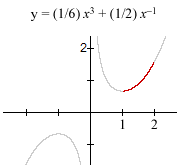
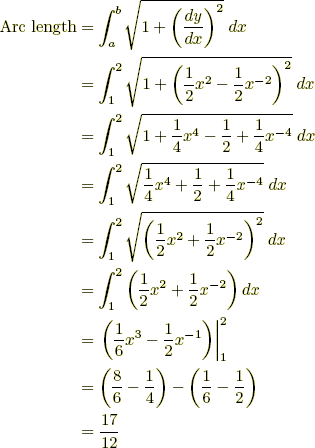
Problem: Find the arc length of the curve y = (1/6)x³ + (1/2)x⁻¹ from x = 1 to x = 2.
Step 1: Find dy/dx by differentiating the function.
dxdy=21x2−21x−2
Step 2: Square the derivative and add 1. Factor the result to simplify the square root.
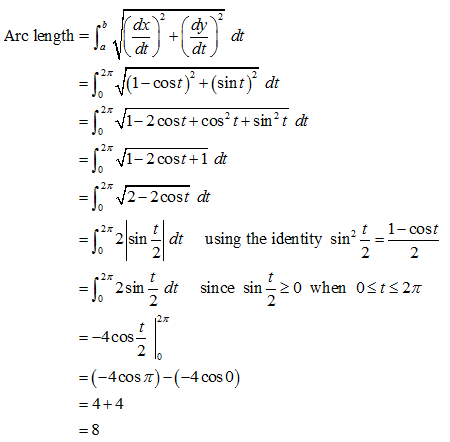
This example uses the parametric arc length formula instead of the rectangular form, and it demonstrates a common trigonometric simplification technique with the half-angle identity.
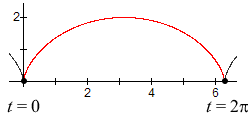
Problem: Find the arc length of one full period of the cycloid defined parametrically by x = t − sin t, y = 1 − cos t, for 0 ≤ t ≤ 2π.
Step 1: Compute the derivatives of x and y with respect to t.
dtdx=1−cost,dtdy=sint
Step 2: Form the expression under the square root.
Answer: The arc length of one arch of the cycloid is 8.
Frequently Asked Questions
What is the difference between arc length and displacement?
Arc length measures the total distance traveled along the curve, accounting for every twist and turn. Displacement is the straight-line distance between the starting and ending points. Arc length is always greater than or equal to the magnitude of displacement.
Why is there a square root in the arc length formula?
The square root comes from the Pythagorean theorem. A tiny piece of the curve has a horizontal change dx and a vertical change dy, so its length is ds = √(dx² + dy²). The arc length integral sums up all these tiny hypotenuse lengths along the curve.
When do you use the parametric arc length formula vs. the rectangular one?
Use the rectangular formula when the curve is given as y = f(x) or x = g(y) and the derivative is straightforward. Use the parametric formula when the curve is defined by separate x(t) and y(t) functions, such as a cycloid or an ellipse traced over time. The rectangular form is actually a special case of the parametric form where the parameter is x itself.
Arc Length of a Curve vs. Arc Length of a Circle
Arc Length of a Curve
Arc Length of a Circle
Definition
Length along any differentiable curve between two points
Length along the circumference of a circle between two points
Formula
L = ∫ₐᵇ √(1 + (dy/dx)²) dx (or parametric/polar variants)
s = rθ, where r is the radius and θ is the central angle in radians
Requires calculus?
Yes — integration is needed
No — it is a direct multiplication
When to use
General curves: parabolas, cycloids, spirals, etc.
Circles only
Why It Matters
Arc length appears throughout calculus, physics, and engineering — for example, when computing the distance a particle travels along a trajectory, the length of a cable hanging in a catenary curve, or the total path of a roller-coaster track. It is also the foundation for the concept of arc length parameterization, which is essential in differential geometry and computer graphics for moving along a curve at constant speed.
Common Mistakes
Mistake: Forgetting to square the derivative before adding 1 inside the square root.
Correction: The formula requires (dy/dx)², not dy/dx. Always square the derivative first: √(1 + (dy/dx)²).
Mistake: Using the wrong variable of integration for the limits. For example, plugging in t-values when the integral is set up with respect to x.
Correction: Make sure your limits match the variable of integration. If you integrate with respect to t, use t-bounds; if with respect to x, use x-bounds. Convert limits if you change variables.
Related Terms
Curve — The geometric object whose length is measured
Differentiable — Curve must be differentiable for the formula