Mathwords logoReference LibraryMathwords

Inverse Tangent

Inverse Tangent
tan-1
Tan-1
arctan
Arctan

The inverse function of tangent.

Basic idea: To find tan-1 1, we ask "what angle has tangent equal to 1?" The answer is 45°. As a result we say that tan-1 1 = 45°. In radians this is tan-1 1 = π/4.

More: There are actually many angles that have tangent equal to 1. We are really asking "what is the simplest, most basic angle that has tangent equal to 1?" As before, the answer is 45°. Thus tan-1 1 = 45° or tan-1 1 = π/4.

Details: What is tan-1 (–1)? Do we choose 135°, –45°, 315° , or some other angle? The answer is –45°. With inverse tangent, we select the angle on the right half of the unit circle having measure as close to zero as possible. Thus tan-1 (–1) = –45° or tan-1 (–1) = –π/4.

In other words, the range of tan-1 is restricted to (–90°, 90°) or The interval from negative pi over 2 to pi over 2, written as (-π/2, π/2).

Note: arctan refers to "arc tangent", or the radian measure of the arc on a circle corresponding to a given value of tangent.

Technical note: Since none of the six trig functions sine, cosine, tangent, cosecant, secant, and cotangent are one-to-one, their inverses are not functions. Each trig function can have its domain restricted, however, in order to make its inverse a function. Some mathematicians write these restricted trig functions and their inverses with an initial capital letter (e.g. Tan or Tan-1). However, most mathematicians do not follow this practice. This website does not distinguish between capitalized and uncapitalized trig functions.
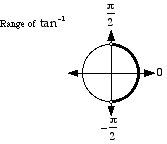
 

Unit circle showing range of tan⁻¹: from -π/2 (bottom) to π/2 (top), with 0 marked on the right.


See also

Inverse trigonometry, inverse trig functions, interval notation

Key Formula

θ=tan1(x)tan(θ)=x,    θ(π2,π2)\theta = \tan^{-1}(x) \quad \Longleftrightarrow \quad \tan(\theta) = x, \;\; \theta \in \left(-\frac{\pi}{2},\, \frac{\pi}{2}\right)
Where:
  • xx = Any real number — the value whose inverse tangent you want to find
  • θ\theta = The output angle, always between −90° and 90° (or −π/2 and π/2 radians), exclusive

Worked Example

Problem: Find tan⁻¹(√3) in both degrees and radians.
Step 1: Ask: what angle θ in (−90°, 90°) satisfies tan(θ) = √3?
tan(θ)=3\tan(\theta) = \sqrt{3}
Step 2: Recall the standard tangent values. From the unit circle, tan(60°) = √3.
tan(60°)=3\tan(60°) = \sqrt{3}
Step 3: Check that 60° is within the allowed range (−90°, 90°). It is, so this is our answer.
90°<60°<90°  -90° < 60° < 90° \; \checkmark
Step 4: Convert to radians: 60° = π/3.
tan1(3)=60°=π3\tan^{-1}(\sqrt{3}) = 60° = \frac{\pi}{3}
Answer: tan⁻¹(√3) = 60° = π/3

Another Example

This example uses a negative input to show that inverse tangent returns a negative angle for negative arguments, and that you must choose the angle in (−90°, 90°) rather than the one in the second quadrant.

Problem: Find tan⁻¹(−√3) in both degrees and radians.
Step 1: Ask: what angle θ in (−90°, 90°) satisfies tan(θ) = −√3?
tan(θ)=3\tan(\theta) = -\sqrt{3}
Step 2: We know tan(60°) = √3. Since tangent is an odd function, tan(−60°) = −√3.
tan(60°)=3\tan(-60°) = -\sqrt{3}
Step 3: Check the range: −60° lies inside (−90°, 90°), so it qualifies.
90°<60°<90°  -90° < -60° < 90° \; \checkmark
Step 4: Note that 120° also has tangent −√3, but 120° is outside the allowed range, so we reject it.
tan1(3)=60°=π3\tan^{-1}(-\sqrt{3}) = -60° = -\frac{\pi}{3}
Answer: tan⁻¹(−√3) = −60° = −π/3

Frequently Asked Questions

What is the difference between arctan and tan⁻¹?
They are the same function. The notation arctan(x) and tan⁻¹(x) both mean "the angle whose tangent is x." The superscript −1 indicates an inverse function, not a reciprocal. The reciprocal 1/tan(x) is written as cot(x).
Why is the range of inverse tangent (−90°, 90°) and not [0°, 180°)?
The range is chosen so that each input gives exactly one output, making inverse tangent a proper function. The interval (−90°, 90°) works because tangent is continuous and strictly increasing there, covering every real number exactly once. Other intervals would leave gaps or create ambiguity.
What is the domain and range of inverse tangent?
The domain of tan⁻¹ is all real numbers (−∞, ∞). You can take the inverse tangent of any real number, no matter how large or small. The range is (−π/2, π/2) in radians, or (−90°, 90°) in degrees. The output never actually equals ±90° because tangent is undefined at those angles.

Inverse Tangent (arctan) vs. Inverse Sine (arcsin)

Inverse Tangent (arctan)Inverse Sine (arcsin)
Notationtan⁻¹(x) or arctan(x)sin⁻¹(x) or arcsin(x)
Domain (input)All real numbers (−∞, ∞)Only [−1, 1]
Range (output)(−π/2, π/2) — open interval[−π/2, π/2] — closed interval
Question it answersWhat angle has this tangent?What angle has this sine?
Horizontal asymptotesy = π/2 and y = −π/2None (domain is bounded)

Why It Matters

Inverse tangent appears constantly in trigonometry and precalculus when you need to recover an angle from a ratio. In physics, you use it to find the direction of a vector from its components—for example, the launch angle of a projectile. In calculus, the derivative of arctan(x) is 1/(1 + x²), which makes it central to many integration problems.

Common Mistakes

Mistake: Confusing tan⁻¹(x) with 1/tan(x).
Correction: The notation tan⁻¹(x) means the inverse tangent function (arctan), not the reciprocal. The reciprocal of tangent is cotangent: cot(x) = 1/tan(x). The −1 superscript on a trig function always denotes the inverse function.
Mistake: Choosing an angle outside the range (−90°, 90°).
Correction: Infinitely many angles share the same tangent value because tangent is periodic. The inverse tangent function always returns the unique angle in the open interval (−90°, 90°). For example, tan⁻¹(−1) = −45°, not 135° or 315°.

Related Terms

  • TangentThe function that arctan reverses
  • Inverse Trig FunctionsThe family arctan belongs to
  • Unit CircleVisual source of standard tangent values
  • Inverse FunctionGeneral concept behind arctan
  • Restricted DomainWhy tangent must be restricted for arctan to exist
  • SineRelated trig function with its own inverse
  • CotangentReciprocal of tangent, often confused with arctan
  • RangeArctan's range is the key to choosing the correct angle