Subset
Subset
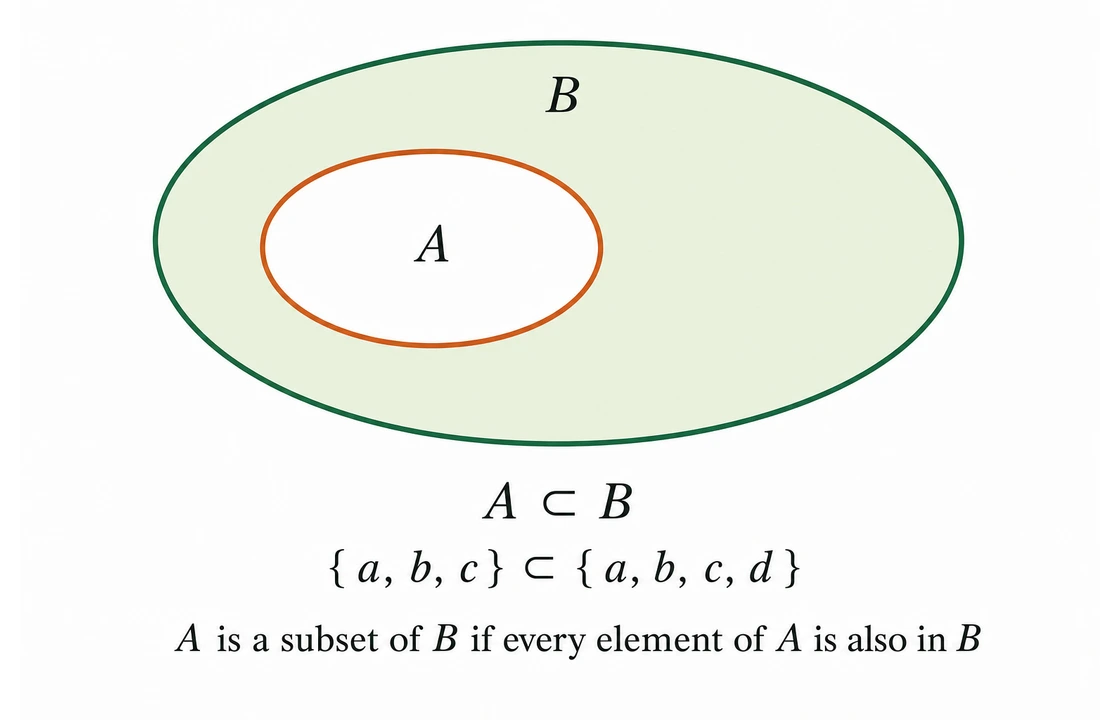
Set A is a subset of set B if all of the elements (if any) of set A are contained in set B. This is written A ⊂ B.
Note: The empty set is a subset of every set.
See also
Key Formula
A⊆B⟺∀x(x∈A⇒x∈B)
Where:
- A = The set being tested as a possible subset
- B = The set that may contain all elements of A
- x = An arbitrary element
- ⊆ = The subset symbol, read 'is a subset of'
- ∀ = The universal quantifier, read 'for all'
- ∈ = The element-of symbol, read 'belongs to'
- ⇒ = Logical implication, read 'implies'
Worked Example
Problem: Let A = {2, 4, 6} and B = {1, 2, 3, 4, 5, 6, 7}. Is A a subset of B?
Step 1: Write out the definition you need to check: every element of A must also be an element of B.
A⊆B⟺∀x(x∈A⇒x∈B)
Step 2: Check the first element of A. Is 2 in B?
2∈B✓
Step 3: Check the second element. Is 4 in B?
4∈B✓
Step 4: Check the third element. Is 6 in B?
6∈B✓
Step 5: Every element of A appears in B, so the subset relationship holds.
A⊆B
Answer: Yes, A = {2, 4, 6} is a subset of B = {1, 2, 3, 4, 5, 6, 7}.
Another Example
This example shows the case where the subset relationship fails. You only need one counterexample — a single element in A that is not in B — to conclude A is not a subset of B.
Problem: Let C = {3, 5, 9} and D = {1, 3, 5, 7}. Is C a subset of D?
Step 1: You need to verify that every element of C belongs to D. If even one element fails, C is not a subset of D.
Step 2: Check: Is 3 in D? Yes.
3∈D✓
Step 3: Check: Is 5 in D? Yes.
5∈D✓
Step 4: Check: Is 9 in D? No, 9 does not appear in {1, 3, 5, 7}.
9∈/D×
Step 5: Because at least one element of C is missing from D, the subset relationship fails.
C⊈D
Answer: No, C is not a subset of D because 9 ∈ C but 9 ∉ D.
Frequently Asked Questions
What is the difference between a subset and a proper subset?
A subset allows the two sets to be equal: A⊆B means every element of A is in B, including the possibility that A and B are identical. A proper subset, written A⊂B (or A⊊B), requires that A is a subset of B and A is not equal to B — so B must contain at least one element not found in A.
Why is the empty set a subset of every set?
The definition says A is a subset of B if every element of A is also in B. The empty set ∅ has no elements at all, so there is no element that could fail the test. The condition is satisfied automatically (this is called being 'vacuously true'). Therefore ∅⊆B for any set B.
Is a set a subset of itself?
Yes. Every element of a set A is trivially contained in A, so A⊆A is always true. This is why the subset relation is called reflexive. If you want to exclude this case, use the proper subset symbol ⊂ instead.
Subset (⊆) vs. Proper Subset (⊂)
| Subset (⊆) | Proper Subset (⊂) | |
|---|---|---|
| Symbol | A⊆B | A⊂B (or A⊊B) |
| Definition | Every element of A is in B | Every element of A is in B, and A ≠ B |
| Can A equal B? | Yes | No |
| Example | {1, 2} ⊆ {1, 2} is true | {1, 2} ⊂ {1, 2} is false |
| Analogy | Like ≤ for numbers | Like < for numbers |
Why It Matters
Subsets appear throughout mathematics whenever you need to describe one collection fitting inside another — for instance, the set of even numbers is a subset of the integers. In probability, events are subsets of the sample space, so understanding subsets is essential for computing probabilities. You will also encounter subsets when working with Venn diagrams, logic proofs, and functions (where the domain and range are subsets of larger sets).
Common Mistakes
Mistake: Confusing the subset symbol ⊆ with the element-of symbol ∈.
Correction: The symbol ∈ relates an element to a set (e.g., 3∈{1,2,3}), while ⊆ relates a set to another set (e.g., {3}⊆{1,2,3}). Note that 3 is an element, but {3} is a set containing that element.
Mistake: Thinking that two sets must be different sizes for one to be a subset of the other.
Correction: A set is always a subset of itself (A⊆A). Equal sets are subsets of each other. Only the proper subset relation (⊂) requires the sets to differ.
Related Terms
- Set — The fundamental object that subsets are drawn from
- Element of a Set — Individual members that make up sets and subsets
- Empty Set — The set with no elements; a subset of every set
- Proper Subset — A subset that is strictly smaller than the parent set
- Superset — The reverse relationship: B ⊇ A means A ⊆ B
- Venn Diagrams — Visual tool for showing subset relationships between sets
