
Probability — Definition, Formula & Examples
Probability
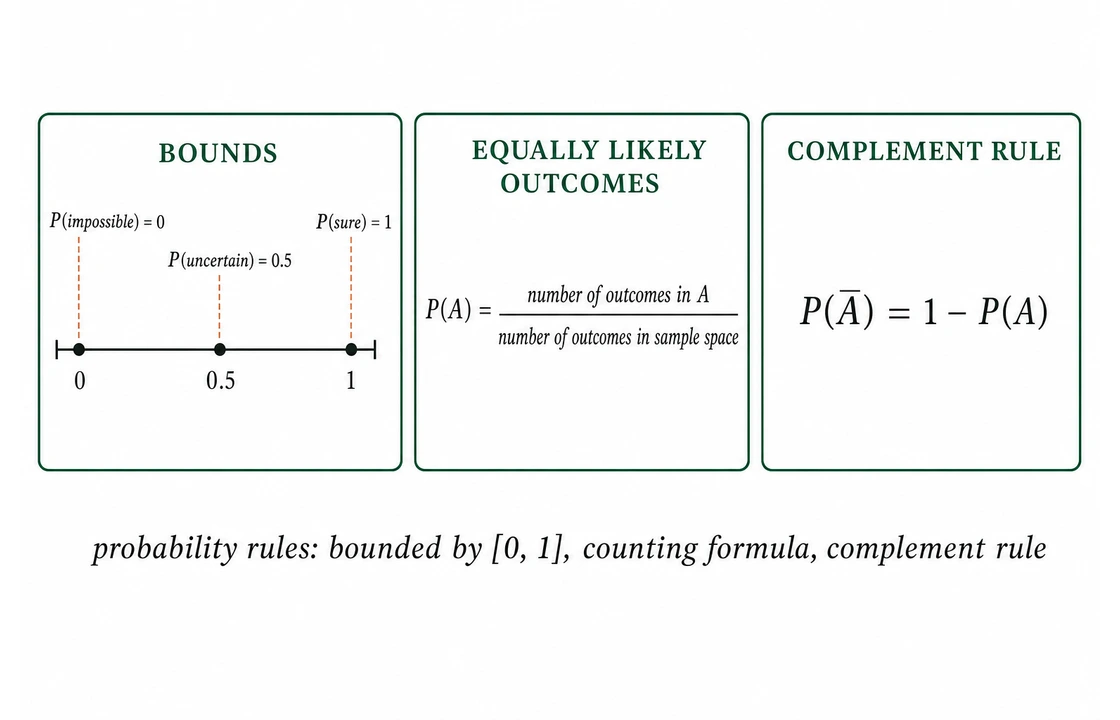
The likelihood of the occurrence of an event. The probability of event A is written P(A). Probabilities are always numbers between 0 and 1, inclusive.
See also
Key Formula
P(A)=Total number of equally likely outcomesNumber of favorable outcomes
Where:
- P(A) = The probability of event A occurring
- Number of favorable outcomes = The count of outcomes in the sample space that belong to event A
- Total number of equally likely outcomes = The total count of outcomes in the sample space, assuming each is equally likely
Worked Example
Problem: A standard deck has 52 cards. What is the probability of drawing a heart?
Step 1: Identify the total number of equally likely outcomes. A standard deck has 52 cards, so the sample space has 52 outcomes.
Total outcomes=52
Step 2: Count the favorable outcomes. There are 13 hearts in a deck.
Favorable outcomes=13
Step 3: Apply the probability formula by dividing favorable outcomes by total outcomes.
P(heart)=5213=41
Step 4: Express as a decimal or percentage if needed.
P(heart)=0.25=25%
Answer: The probability of drawing a heart is 1/4, or 0.25, or 25%.
Another Example
This example uses the complement rule (Rule 4) instead of directly counting favorable outcomes, showing how to find the probability of an event NOT happening.
Problem: You roll a fair six-sided die. What is the probability of NOT rolling a 5?
Step 1: First find the probability of rolling a 5. There is 1 favorable outcome out of 6 equally likely outcomes.
P(5)=61
Step 2: Use the complement rule: P(not A) = 1 − P(A).
P(not 5)=1−P(5)=1−61
Step 3: Simplify the subtraction.
P(not 5)=66−61=65
Answer: The probability of NOT rolling a 5 is 5/6, which is approximately 0.833 or about 83.3%.
Frequently Asked Questions
What is the difference between probability and odds?
Probability compares favorable outcomes to total outcomes, giving a value between 0 and 1. Odds compare favorable outcomes to unfavorable outcomes, expressed as a ratio like 3:2. For example, if the probability of winning is 3/5, the odds in favor are 3:2 (3 favorable vs. 2 unfavorable).
Can probability be greater than 1 or less than 0?
No. By definition, probability is always between 0 and 1 inclusive. A value of 0 means the event is impossible, and a value of 1 means it is certain. If your calculation gives a number outside this range, you have made an error.
How do you find the probability of two events happening together?
If two events A and B are independent (one does not affect the other), you multiply their probabilities: P(A and B) = P(A) × P(B). If they are not independent, you use the general multiplication rule: P(A and B) = P(A) × P(B | A), where P(B | A) is the probability of B given that A has occurred.
Probability vs. Odds
| Probability | Odds | |
|---|---|---|
| Definition | Ratio of favorable outcomes to total outcomes | Ratio of favorable outcomes to unfavorable outcomes |
| Formula | P(A) = favorable / total | Odds in favor = favorable : unfavorable |
| Range of values | 0 to 1 (or 0% to 100%) | 0 to infinity (e.g., 1:5, 3:1) |
| When to use | Statistics, science, most math courses | Gambling, betting, everyday language |
Why It Matters
Probability appears throughout statistics, science, and everyday decision-making—from predicting weather to assessing medical test results. In math courses, it forms the foundation for topics like expected value, binomial distributions, and hypothesis testing. Understanding probability also helps you evaluate risk and make informed choices in real life.
Common Mistakes
Mistake: Confusing probability with odds. For instance, writing the probability of rolling a 6 on a die as "1:5" instead of 1/6.
Correction: Probability is favorable outcomes divided by total outcomes (1/6), while odds compare favorable to unfavorable outcomes (1:5). These are related but not the same value.
Mistake: Forgetting to check that all outcomes are equally likely before using the formula P(A) = favorable/total.
Correction: The basic probability formula only works when every outcome in the sample space has the same chance. For example, if a spinner has sections of different sizes, you cannot simply count sections—you must account for their areas.
Related Terms
- Event — A set of outcomes whose probability you calculate
- Sample Space — The set of all possible outcomes of an experiment
- Outcome — A single result within the sample space
- Complement of an Event — All outcomes not in the event; P(Aᶜ) = 1 − P(A)
- Addition Rule — Finds probability of A or B occurring
- Multiplication Rule — Finds probability of A and B both occurring
- Odds — An alternative way to express likelihood of an event
- Experiment — The process that produces the outcomes