
Natural Numbers — Definition, Examples & Table
Natural Numbers
Counting Numbers
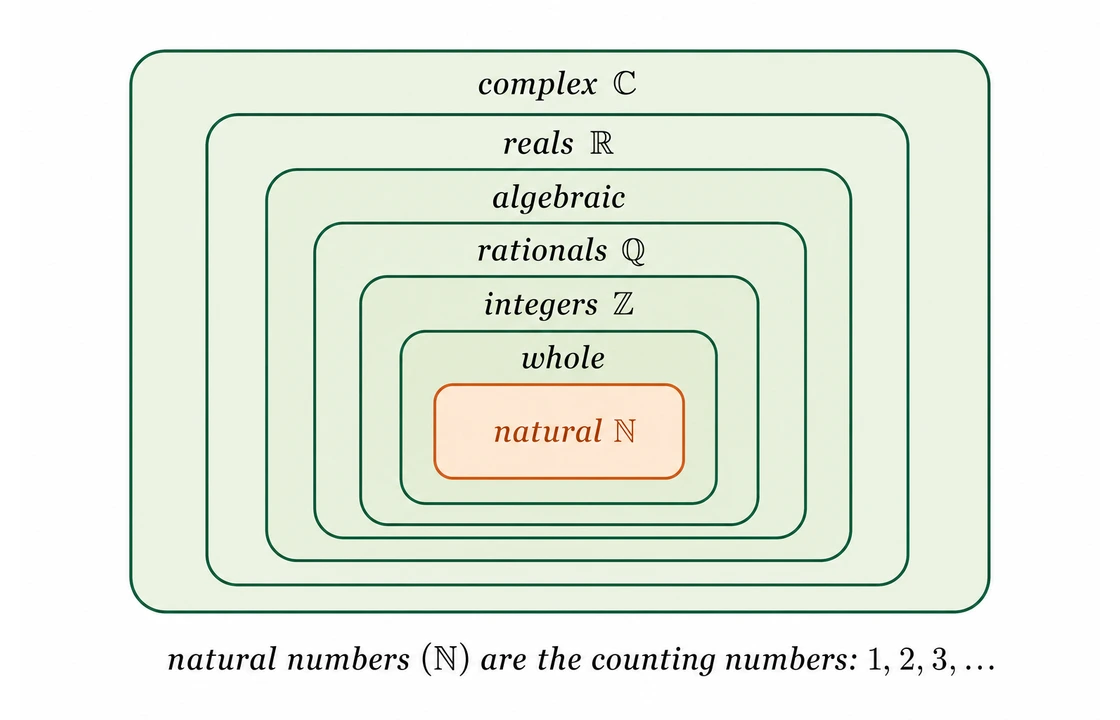
The numbers used for counting. That is, the numbers 1, 2, 3, 4, etc.
See also
Whole numbers, integers, rational numbers, algebraic numbers, real numbers, imaginary numbers, complex numbers
Key Formula
N={1,2,3,4,5,…}
Where:
- N = The standard symbol for the set of natural numbers
- … = Indicates the pattern continues infinitely
Worked Example
Problem: Determine which of the following are natural numbers: 7, −3, 0, 4.5, 12.
Step 1: Recall that natural numbers are the positive counting numbers: 1, 2, 3, 4, ...
N={1,2,3,4,5,…}
Step 2: Check 7: It is a positive whole number used for counting, so 7 is a natural number.
7∈N✓
Step 3: Check −3: It is negative, so it is not a natural number.
−3∈/N
Step 4: Check 0: Zero is not used for counting objects (you don't start counting at zero), so 0 is not a natural number. It belongs to the whole numbers instead.
0∈/N
Step 5: Check 4.5 and 12: The value 4.5 is a decimal (not a whole counting number), so it is not natural. The value 12 is a positive counting number, so it is natural.
4.5∈/N,12∈N
Answer: The natural numbers in the list are 7 and 12.
Another Example
This example shows a computational application of natural numbers rather than classification. It introduces the classic summation formula and demonstrates how natural numbers are used in arithmetic sequences.
Problem: Find the sum of the first 10 natural numbers.
Step 1: List the first 10 natural numbers.
1,2,3,4,5,6,7,8,9,10
Step 2: Use the formula for the sum of the first n natural numbers, attributed to Gauss.
S=2n(n+1)
Step 3: Substitute n = 10 into the formula.
S=210×11=2110=55
Answer: The sum of the first 10 natural numbers is 55.
Frequently Asked Questions
Is 0 a natural number?
This depends on the convention. In most U.S. math courses and the definition used here, 0 is NOT a natural number — natural numbers start at 1. However, some textbooks (especially in logic, set theory, and European traditions) define natural numbers to include 0. Always check which convention your course uses.
What is the difference between natural numbers and whole numbers?
Natural numbers are {1, 2, 3, 4, ...}, while whole numbers are {0, 1, 2, 3, 4, ...}. The only difference is that whole numbers include zero. Every natural number is a whole number, but 0 is a whole number that is not a natural number.
Are natural numbers infinite?
Yes. There is no largest natural number. For any natural number n, you can always find a larger one by computing n + 1. This means the set of natural numbers is countably infinite — it goes on forever, but you can still list its elements in order.
Natural Numbers vs. Whole Numbers
| Natural Numbers | Whole Numbers | |
|---|---|---|
| Definition | Positive counting numbers: {1, 2, 3, ...} | Non-negative integers: {0, 1, 2, 3, ...} |
| Includes zero? | No | Yes |
| Symbol | ℕ | 𝕎 or ℕ₀ |
| Smallest element | 1 | 0 |
| Common use | Counting objects (1st, 2nd, 3rd...) | Counting including 'none' (0 items) |
Why It Matters
Natural numbers appear constantly in algebra, number theory, and sequences. When you see summation notation like ∑k=1n, the index k runs through natural numbers. Understanding which numbers are natural helps you correctly interpret domain restrictions, identify valid inputs for formulas like factorials (n! requires n∈N or n=0), and classify numbers in set theory questions on exams.
Common Mistakes
Mistake: Including 0 as a natural number when the course defines natural numbers as starting at 1.
Correction: Check your textbook's convention. In most U.S. pre-algebra and algebra courses, natural numbers begin at 1. The set that includes 0 is called the whole numbers.
Mistake: Thinking that all positive numbers are natural numbers.
Correction: Numbers like 3.7, ½, and √2 are positive but not natural. Natural numbers must be positive AND whole (no fractions or decimals). Only 1, 2, 3, 4, ... qualify.
Related Terms
- Whole Numbers — Natural numbers plus zero
- Integers — Whole numbers extended to include negatives
- Rational Numbers — Fractions formed from integers, includes naturals
- Algebraic Numbers — Broader set containing all natural numbers
- Real Numbers — All points on the number line, includes naturals
- Imaginary Numbers — Numbers outside the real number line
- Complex Numbers — Largest standard set, combines real and imaginary