
Intersection — Definition, Symbol & Examples
Intersection of Sets
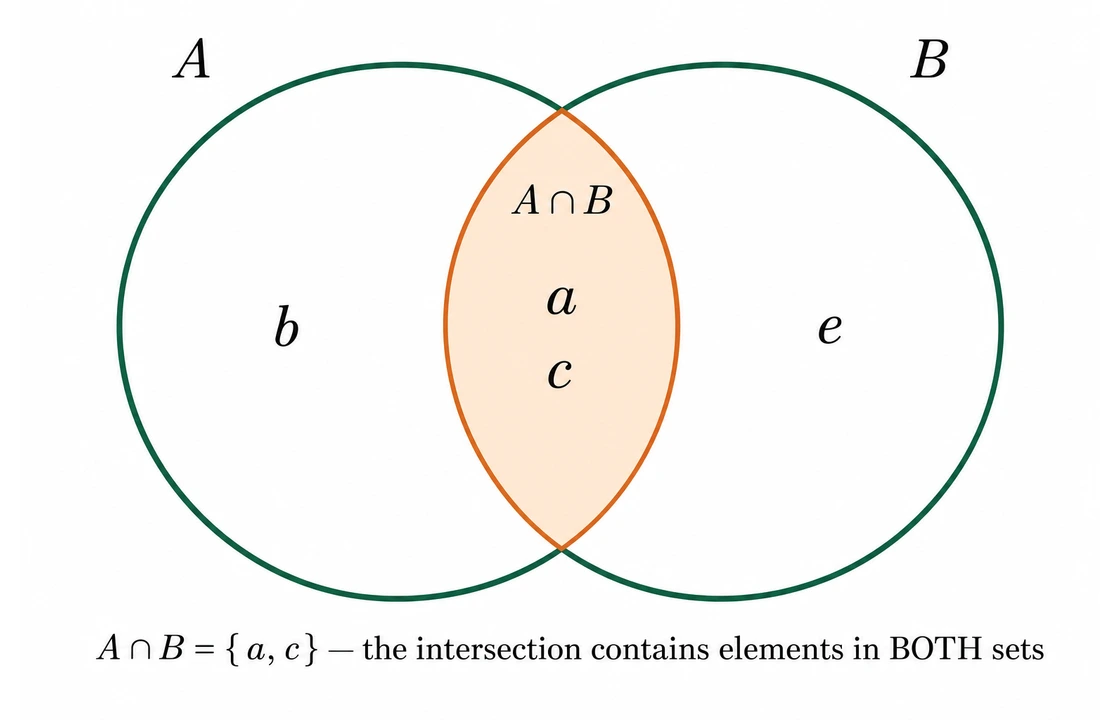
The elements two or more sets have in common. Intersection is indicated by the ∩ (cap) symbol.
See also
Key Formula
A∩B={x∣x∈A and x∈B}
Where:
- A,B = Two sets being compared
- x = An element that belongs to both A and B
- ∩ = The intersection operator (read as 'cap' or 'intersect')
Worked Example
Problem: Find the intersection of A = {1, 2, 3, 4, 5} and B = {2, 4, 6, 8}.
Step 1: List the elements of set A.
A={1,2,3,4,5}
Step 2: List the elements of set B.
B={2,4,6,8}
Step 3: Check each element of A to see if it also appears in B. The element 1 is not in B. The element 2 is in B. The element 3 is not in B. The element 4 is in B. The element 5 is not in B.
Step 4: Collect all elements common to both sets.
A∩B={2,4}
Answer: A ∩ B = {2, 4}
Another Example
This example extends intersection to three sets, showing that an element must be in every set to appear in the result.
Problem: Find the intersection of three sets: P = {a, b, c, d}, Q = {b, c, e, f}, and R = {c, d, e, g}.
Step 1: To find P ∩ Q ∩ R, an element must belong to all three sets. Start by finding P ∩ Q: the elements common to P and Q.
P∩Q={b,c}
Step 2: Now intersect that result with R. Check which elements of {b, c} are also in R. The element b is not in R. The element c is in R.
(P∩Q)∩R={c}
Step 3: Write the final result.
P∩Q∩R={c}
Answer: P ∩ Q ∩ R = {c}
Frequently Asked Questions
What is the difference between intersection and union of sets?
Intersection (A ∩ B) gives you only the elements that appear in both A and B — the overlap. Union (A ∪ B) gives you all elements that appear in either A or B (or both). Intersection typically produces a smaller set, while union produces a larger one.
What happens when two sets have no elements in common?
When two sets share no elements, their intersection is the empty set, written as ∅ or {}. Sets with an empty intersection are called disjoint sets. For example, {1, 2} ∩ {3, 4} = ∅.
Can you intersect more than two sets at once?
Yes. When you intersect three or more sets, the result contains only the elements that appear in every single set. You can compute it step by step — find the intersection of the first two sets, then intersect that result with the next set, and so on. The order does not matter because intersection is both commutative and associative.
Intersection (∩) vs. Union (∪)
| Intersection (∩) | Union (∪) | |
|---|---|---|
| Definition | Elements common to all given sets | All elements from any of the given sets |
| Symbol | ∩ (cap) | ∪ (cup) |
| Result size | Always ≤ the smallest input set | Always ≥ the largest input set |
| Logical equivalent | AND — element must be in A and B | OR — element must be in A or B (or both) |
| Example: {1,2,3} and {2,3,4} | {2, 3} | {1, 2, 3, 4} |
Why It Matters
Intersection appears frequently in probability, where the intersection of two events represents outcomes that satisfy both conditions at once — this is directly used in calculating P(A ∩ B). You will also encounter it in coordinate geometry when finding the intersection of solution sets for systems of inequalities. In data science and computer programming, intersection operations on data sets are essential for filtering and querying information.
Common Mistakes
Mistake: Confusing the ∩ (cap) symbol with ∪ (cup) and accidentally finding the union instead of the intersection.
Correction: Remember that ∩ looks like an upside-down U or a cap — it "caps" the result to only the shared elements. The ∪ looks like a cup that collects everything together. A helpful mnemonic: ∩ for 'iNtersection' (N-shape).
Mistake: Including an element in the intersection even though it only appears in one of the sets.
Correction: An element must appear in every set involved. Carefully check each candidate element against all sets before including it in the result. If it is missing from even one set, it does not belong in the intersection.
Related Terms
- Union — Combines all elements from given sets
- Set — The fundamental collection that intersection operates on
- Element of a Set — Individual members checked during intersection
- Set Subtraction — Removes one set's elements from another
- Venn Diagrams — Visual tool showing intersection as overlapping region