Mathwords logoMathwords

Integral Table

Integral Table

For the following, the letters a, b, n, and C represent constants.

Note: Most of the following integral entries are written for indefinite integrals, but they also apply to definite integrals.

Basic Forms

1. Integral formula: the integral of u^n du equals 1/(n+1) times u^(n+1) plus C, where n ≠ –1

2. Integral formula: ∫u⁻¹ du = ∫(1/u) du = ln|u| + C

3. Integral formula: the integral of e^u du equals e^u plus C

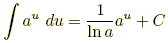
4. Integral formula: ∫a^u du = (1/ln a)a^u + C, where a > 0 and a ≠ 1, where a > 0 and a ≠ 1

5. Integral formula: the integral of sin u du equals negative cos u plus C

6. Integral formula: the integral of cos u du equals sin u plus C

7. Integral formula: the integral of sec²u du equals tan u plus C

8. Integral formula: the integral of sec u tan u du equals sec u plus C

9. Integral formula: the integral of csc²(u) du equals negative cot(u) plus C

10. Integral formula: the integral of csc u cot u du equals negative csc u plus C

11. Integral formula: ∫f(au+b)du = (1/a)F(au+b)+C, where F(u) is an antiderivative of f(u), where F(u) is an antiderivative of f(u)

Other Basic Trig and Inverse Trig Forms

12. Integral of tan u du equals ln|sec u| + C, which also equals negative ln|cos u| + C

13. Integral formula: the integral of sec u du equals ln |sec u + tan u| + C

14. Integral of cot u du equals negative ln|csc u| plus C, equals ln|sin u| plus C

15. Integral formula: ∫csc u du = ln|csc u − cot u| + C

16. Integral of 1 over square root of (1 minus u squared) du equals arcsin(u) plus C

17. Integral formula: ∫ 1/√(a²−u²) du = sin⁻¹(u/a) + C for a > 0

18. Integral formula: ∫ 1/(1 + u²) du = tan⁻¹ u + C

19. Integral formula: ∫ 1/(a² + u²) du = (1/a) tan⁻¹(u/a) + C for a > 0

20. Integral of 1/(u√(u²−1)) du = sec⁻¹(u) + C for u > 1

21. Integral formula: ∫ 1/(u√(u²−a²)) du = (1/a)sec⁻¹(u/a) + C for u > a > 0


Basic Rational Forms

22. Integral formula: ∫1/(a²−u²) du = (1/2a) ln|(a+u)/(a−u)| + C for a > 0

23. Integral formula: ∫ 1/(u²−a²) du = 1/(2a) · ln|( u−a)/(u+a)| + C for a > 0


Trig Forms

24. Integral formula: ∫sin²u du = (1/2)u − (1/4)sin 2u + C

25. Integral formula: ∫cos²u du = (1/2)u + (1/4)sin2u + C

26. Integral formula: ∫sec³u du = (1/2)sec u tan u + (1/2)ln|sec u + tan u| + C


Inverse Trig Forms

27. Integral formula: ∫ sin⁻¹(u) du = u·sin⁻¹(u) + √(1 − u²) + C

28. Integral formula: ∫ cos⁻¹(u) du = u·cos⁻¹(u) − √(1 − u²) + C

29. Integral formula: ∫ tan⁻¹(u) du = u·tan⁻¹(u) − (1/2)·ln(u² + 1) + C

30. Integral of cot⁻¹(u) du = u·cot⁻¹(u) + (1/2)·ln(u² + 1) + C

31. Integral formula: ∫sec⁻¹(u) du = u·sec⁻¹(u) − ln(u + √(u²−1)) + C for u > 1

32. Integral formula: ∫csc⁻¹(u) du = u·csc⁻¹(u) + ln(u + √(u²−1)) + C for u > 1


Forms Involving
Square root of (a squared minus u squared)

33. Integral formula: ∫√(a²−u²) du = (1/2)u√(a²−u²) + (a²/2)sin⁻¹(u/a) + C for a > 0


Forms Involving
Square root of (a squared plus u squared)

34. Integral of sqrt(a²+u²) du = (1/2)u·sqrt(a²+u²) + (a²/2)·ln(u + sqrt(a²+u²)) + C

Forms Involving Square root of (u squared minus a squared)

35. Integral formula: ∫√(u²−a²) du = (1/2)u√(u²−a²) − (a²/2)ln(u+√(u²−a²)) + C for u > a > 0


Forms Involving  au + b

36. Integral formula: ∫√(au + b) du = (2/3a)(au + b)^(3/2) + C

37. Integral formula: ∫u√(au+b) du = 2/(15a²) (3au−2b)(au+b)^(3/2) + C


Exponential Forms

38. Integral formula: the integral of e^(au) du equals (1/a)e^(au) + C

39. Integral formula: ∫ue^(au) du = (1/a²)(au − 1)e^(au) + C

40. Integral formula: ∫u²eᵃᵘ du = (1/a³)(a²u² − 2au + 2)eᵃᵘ + C

41. Integral formula: ∫e^(au) sin(bu) du = 1/(a²+b²) · e^(au) · (a sin(bu) − b cos(bu)) + C

42. Integral formula: ∫e^(au) cos(bu) du = 1/(a²+b²) · e^(au) · (a·cos(bu) + b·sin(bu)) + C


Logarithmic Forms

43. Integral formula: the integral of ln u du equals u times ln u minus u plus C


Definite Integrals

44. Definite integral from negative infinity to positive infinity of e raised to negative x squared dx equals square root of pi


See also

Integration methods, integral rules

Key Formula

undu=un+1n+1+C,n1\int u^n \, du = \frac{u^{n+1}}{n+1} + C, \quad n \neq -1
Where:
  • uu = The variable of integration (or a function of the variable)
  • nn = A constant exponent, where n ≠ −1
  • CC = The constant of integration

Worked Example

Problem: Use an integral table to evaluate ∫ x³ cos(x⁴) dx.
Step 1: Identify a substitution that transforms the integrand into a standard table form. Let u = x⁴, so du = 4x³ dx, which means x³ dx = du/4.
u=x4,du=4x3dxx3dx=du4u = x^4, \quad du = 4x^3\,dx \quad \Rightarrow \quad x^3\,dx = \frac{du}{4}
Step 2: Rewrite the integral in terms of u.
x3cos(x4)dx=14cos(u)du\int x^3 \cos(x^4)\,dx = \frac{1}{4}\int \cos(u)\,du
Step 3: Look up the cosine entry in the integral table: ∫ cos(u) du = sin(u) + C.
cos(u)du=sin(u)+C\int \cos(u)\,du = \sin(u) + C
Step 4: Apply the table result and substitute back for u.
14sin(u)+C=14sin(x4)+C\frac{1}{4}\sin(u) + C = \frac{1}{4}\sin(x^4) + C
Answer: x3cos(x4)dx=14sin(x4)+C\int x^3 \cos(x^4)\,dx = \frac{1}{4}\sin(x^4) + C

Another Example

This example uses the rational-form section of the table directly, with no substitution needed beyond matching parameters. It shows how to identify the constant a from your integrand.

Problem: Use an integral table to evaluate ∫ dx / (x² + 9).
Step 1: Recognize the form. The integral table lists: ∫ du/(u² + a²) = (1/a) arctan(u/a) + C for a > 0.
duu2+a2=1aarctan ⁣(ua)+C\int \frac{du}{u^2 + a^2} = \frac{1}{a}\arctan\!\left(\frac{u}{a}\right) + C
Step 2: Match your integrand to the table entry. Here u = x and a² = 9, so a = 3.
u=x,a=3u = x, \quad a = 3
Step 3: Substitute directly into the table formula.
dxx2+9=13arctan ⁣(x3)+C\int \frac{dx}{x^2 + 9} = \frac{1}{3}\arctan\!\left(\frac{x}{3}\right) + C
Answer: dxx2+9=13arctan ⁣(x3)+C\int \frac{dx}{x^2 + 9} = \frac{1}{3}\arctan\!\left(\frac{x}{3}\right) + C

Frequently Asked Questions

How do you use an integral table?
First, examine your integrand and try to match it to one of the standard forms listed in the table. You may need a u-substitution or algebraic manipulation (like completing the square) to get your integral into a recognizable form. Once you find a match, substitute your specific constants and variable into the formula, then add the constant of integration C.
Do you need to memorize the integral table?
You should memorize the most common entries—power rule, basic trig integrals, exponential, and 1/u—since these appear constantly. More specialized entries (inverse trig forms, forms involving square roots) are typically provided on formula sheets during exams or can be looked up. Knowing the table's organization helps you find what you need quickly.
What is the difference between an integral table and integral rules?
Integral rules are general techniques that apply to broad classes of integrals, such as the constant multiple rule, sum rule, integration by parts, or substitution. An integral table is a pre-computed list of specific results obtained by applying those rules. Think of rules as the methods and the table as a collection of ready-made answers.

Integral Table vs. Integral Rules

Integral TableIntegral Rules
What it isA reference list of specific antiderivative formulasGeneral techniques for finding antiderivatives (substitution, by parts, etc.)
How you use itMatch your integrand to a listed form and apply the formula directlyApply a method step-by-step to transform and solve the integral
Best forQuickly evaluating standard integrals or as a starting point before further simplificationHandling integrals that don't match any table entry or require multi-step reasoning
Example∫ sec²(u) du = tan(u) + C (looked up)Use u-substitution with u = 3x to convert ∫ sec²(3x) dx into a table form

Why It Matters

Integral tables appear throughout calculus courses, physics, and engineering whenever you need to evaluate integrals efficiently. On timed exams, matching an integrand to a table entry can save several minutes compared to deriving the antiderivative from scratch. Understanding how to read and apply these tables is also essential preparation for techniques like partial fractions and trigonometric substitution, where the final step often involves a table lookup.

Common Mistakes

Mistake: Forgetting to account for chain-rule factors when the argument is not just a simple variable.
Correction: If your integrand has, say, cos(3x) instead of cos(u), you must account for the derivative of the inner function. Use substitution (u = 3x, du = 3 dx) so that the extra factor of 3 is handled before applying the table entry.
Mistake: Using a table entry whose conditions are not satisfied, such as applying ∫ uⁿ du = uⁿ⁺¹/(n+1) + C when n = −1.
Correction: Always check the restrictions listed with each entry. When n = −1, the correct formula is ∫ u⁻¹ du = ln|u| + C, which is a separate table entry.

Related Terms