
Identity Matrix — Definition, Properties & Examples
Identity Matrix
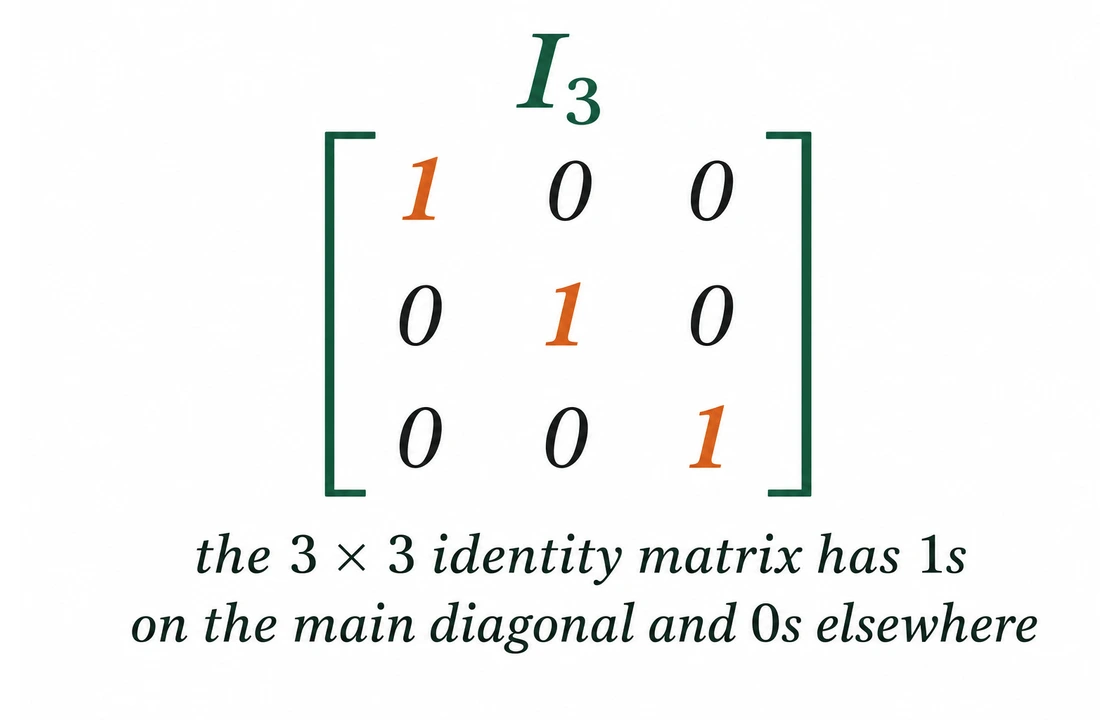
A square matrix which has a 1 for each element on the main diagonal and 0 for all other elements.
Note: The identity
matrix is the identity for matrix
multiplication.
See also
Key Formula
In=10⋮001⋮0⋯⋯⋱⋯00⋮1
Where:
- In = The identity matrix of size n × n
- n = The number of rows and columns (the matrix must be square)
- 1 = Each entry on the main diagonal (where row index equals column index)
- 0 = Every entry not on the main diagonal
Worked Example
Problem: Multiply the matrix A by the 2×2 identity matrix, where A = [[3, 7], [5, 2]].
Step 1: Write out the 2×2 identity matrix.
I2=[1001]
Step 2: Set up the multiplication A · I₂.
A⋅I2=[3572][1001]
Step 3: Compute each entry using the row-by-column rule. For example, the top-left entry is (3)(1) + (7)(0) = 3, and the top-right entry is (3)(0) + (7)(1) = 7.
A⋅I2=[3⋅1+7⋅05⋅1+2⋅03⋅0+7⋅15⋅0+2⋅1]
Step 4: Simplify to get the result.
A⋅I2=[3572]
Answer: A · I₂ = A. The matrix is unchanged, confirming that the identity matrix is the multiplicative identity.
Another Example
This example focuses on constructing and verifying the identity matrix using its element-wise definition, rather than demonstrating the multiplication property.
Problem: Write the 3×3 identity matrix and verify that it satisfies the element-wise definition: entry (i, j) equals 1 when i = j and 0 when i ≠ j.
Step 1: Construct the 3×3 identity matrix by placing 1s on the main diagonal (positions (1,1), (2,2), (3,3)) and 0s elsewhere.
I3=100010001
Step 2: Express this using the Kronecker delta notation, where each entry is defined by a simple rule.
(I3)ij=δij={10if i=jif i=j
Step 3: Check a few entries. Entry (1,1): i = j = 1, so the value is 1. ✓ Entry (2,3): i = 2 ≠ 3 = j, so the value is 0. ✓ Entry (3,3): i = j = 3, so the value is 1. ✓
Answer: The 3×3 identity matrix is [[1,0,0],[0,1,0],[0,0,1]], and every entry matches the rule: 1 when the row equals the column, 0 otherwise.
Frequently Asked Questions
Why is the identity matrix important?
The identity matrix plays the same role in matrix algebra that the number 1 plays in ordinary multiplication. Any matrix A multiplied by the appropriately sized identity matrix gives back A. This property is essential when solving systems of linear equations, computing matrix inverses, and performing matrix transformations.
What is the difference between the identity matrix and the zero matrix?
The identity matrix has 1s on the main diagonal and 0s elsewhere; it is the multiplicative identity, so A · I = A. The zero matrix has 0 in every entry; it is the additive identity, so A + O = A. The identity matrix preserves a matrix under multiplication, while the zero matrix preserves a matrix under addition.
Can the identity matrix be non-square?
No. The identity matrix must be square (same number of rows and columns). This is because it needs to work as a multiplicative identity on both sides: A · Iₙ = A and Iₘ · A = A. Both of these conditions require the identity matrix to be square. You will see identity matrices written as I₂, I₃, I₄, and so on, where the subscript denotes the size.
Identity Matrix vs. Zero Matrix
| Identity Matrix | Zero Matrix | |
|---|---|---|
| Definition | Square matrix with 1s on the diagonal, 0s elsewhere | Matrix with 0 in every entry (any dimensions) |
| Role | Multiplicative identity: A · I = A | Additive identity: A + O = A |
| Must be square? | Yes, always n × n | No, can be any size m × n |
| Determinant | det(I) = 1 | det(O) = 0 (if square) |
| Invertible? | Yes — its own inverse (I⁻¹ = I) | No — never invertible |
Why It Matters
The identity matrix appears throughout linear algebra and its applications. When you find the inverse of a matrix, you row-reduce the augmented matrix [A | I] until the left side becomes I. In computer graphics, transformations like rotation and scaling start from the identity matrix as a "do nothing" baseline, and in systems of equations, the identity matrix signals that you have isolated each variable.
Common Mistakes
Mistake: Using the wrong size identity matrix when multiplying. For example, trying to multiply a 2×3 matrix by I₂ on the right.
Correction: For A · I to work, the identity matrix must have the same number of rows as A has columns. A 2×3 matrix A requires I₃ on the right (A · I₃) and I₂ on the left (I₂ · A).
Mistake: Confusing the identity matrix with a matrix of all 1s.
Correction: The identity matrix has 1s only on the main diagonal; all other entries are 0. A matrix filled entirely with 1s is sometimes called the "ones matrix" or J matrix, and it does not preserve a matrix under multiplication.
Related Terms
- Square Matrix — Identity matrices are always square
- Element of a Matrix — Entries defined by diagonal position
- Main Diagonal of a Matrix — Location of the 1s in the identity
- Identity — General concept the identity matrix exemplifies
- Matrix Multiplication — Operation for which the identity matrix is neutral
- Dimensions of a Matrix — Must match correctly when using I
- Inverse of a Matrix — A · A⁻¹ = I defines the inverse