Discriminant of a Quadratic: b² − 4ac (With Sign Rules)
Discriminant
of a Quadratic
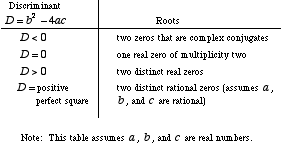
The number D = b2 – 4ac determined
from the coefficients of the equationax2 +
bx + c = 0.
The discriminant reveals what type of roots the equation has.
a = Coefficient of x² in the quadratic equation ax² + bx + c = 0 (a ≠ 0)
b = Coefficient of x
c = Constant term
Worked Example
Problem: Determine the number and type of roots of the equation 2x² + 7x + 3 = 0 using the discriminant.
Step 1: Identify the coefficients a, b, and c from the equation.
a=2,b=7,c=3
Step 2: Substitute into the discriminant formula.
D=b2−4ac=(7)2−4(2)(3)
Step 3: Compute each part and simplify.
D=49−24=25
Step 4: Interpret the result. Since D = 25 > 0, the equation has two distinct real roots. Also, because 25 is a perfect square and all coefficients are rational, the roots are rational numbers.
Answer: The discriminant is 25. The equation has two distinct real, rational roots.
Another Example
This example shows the case where D < 0, meaning no real roots exist — a key contrast to the first example where D > 0. It also demonstrates how the discriminant connects to the quadratic formula.
Problem: Use the discriminant to determine the nature of the roots of x² + 4x + 5 = 0.
Step 1: Identify the coefficients.
a=1,b=4,c=5
Step 2: Substitute into the discriminant formula.
D=(4)2−4(1)(5)=16−20
Step 3: Simplify.
D=−4
Step 4: Since D < 0, the equation has no real roots. Instead, it has two complex conjugate roots. You can verify by applying the quadratic formula:
x=2−4±−4=2−4±2i=−2±i
Answer: The discriminant is −4. The equation has two complex conjugate roots: x = −2 + i and x = −2 − i.
Frequently Asked Questions
What does the discriminant tell you about a quadratic equation?
The discriminant tells you how many and what type of roots a quadratic equation has, without requiring you to solve it. If D > 0, there are two distinct real roots. If D = 0, there is exactly one repeated real root (a root with multiplicity 2). If D < 0, there are no real roots — instead, there are two complex conjugate roots.
What happens when the discriminant equals zero?
When D = 0, the quadratic equation has exactly one real root, often called a repeated or double root. Graphically, this means the parabola just touches the x-axis at one point (its vertex sits on the x-axis). For example, x² − 6x + 9 = 0 has D = 36 − 36 = 0, and its only root is x = 3.
How do you know if the roots are rational or irrational from the discriminant?
If D > 0 and is a perfect square (like 1, 4, 9, 16, 25, …) and the coefficients a, b, c are all rational, then the two roots are rational. If D > 0 but is not a perfect square, the roots are irrational. This works because the quadratic formula includes √D, and the square root of a non-perfect-square is irrational.
Discriminant vs. Quadratic Formula
Discriminant
Quadratic Formula
What it is
A single number: D = b² − 4ac
A formula that gives the actual roots: x = (−b ± √D) / 2a
What it tells you
The number and type of roots (real, repeated, or complex)
The exact values of the roots
When to use
When you only need to classify the roots without solving
When you need the actual root values
Relationship
Appears under the square root in the quadratic formula
Contains the discriminant as the expression under the radical
Why It Matters
The discriminant appears frequently in algebra courses and standardized tests when questions ask about the nature of roots without requiring you to solve the equation. It is also essential in graphing: the sign of the discriminant tells you whether a parabola crosses the x-axis twice, just touches it, or misses it entirely. Beyond algebra, discriminants generalize to higher-degree polynomials and appear in topics like conic sections and differential equations.
Common Mistakes
Mistake: Forgetting the negative sign when b is negative, leading to an incorrect value of b².
Correction: Remember that squaring a negative number gives a positive result. For instance, if b = −6, then b² = (−6)² = 36, not −36. Write out the parentheses to avoid sign errors.
Mistake: Forgetting to rearrange the equation into standard form ax² + bx + c = 0 before identifying a, b, and c.
Correction: The discriminant formula only applies when the equation is in the form ax² + bx + c = 0. If your equation is, say, 3x² + 5 = 2x, first rewrite it as 3x² − 2x + 5 = 0, so a = 3, b = −2, and c = 5.
Related Terms
Quadratic Formula — The discriminant is the expression under its square root
Quadratic Equation — The equation whose roots the discriminant classifies
Root — Solutions whose number and type the discriminant reveals
Coefficient — The values a, b, c used in the discriminant