
Discontinuous Function — Definition, Graph & Examples
See also
Key Formula
A function f is discontinuous at x=c if x→climf(x)=f(c), or if the limit or f(c) does not exist.
Where:
- f = The function being examined for continuity
- c = The specific x-value where the function may be discontinuous
- limx→cf(x) = The limit of f(x) as x approaches c
Worked Example
Problem: Determine whether the piecewise function f(x) is discontinuous at x = 2, where f(x) = x + 1 for x < 2 and f(x) = 5 for x ≥ 2.
Step 1: Find f(2) by using the rule that applies when x ≥ 2.
f(2)=5
Step 2: Find the left-hand limit as x approaches 2 from below, using the rule f(x) = x + 1.
x→2−limf(x)=2+1=3
Step 3: Find the right-hand limit as x approaches 2 from above, using the rule f(x) = 5.
x→2+limf(x)=5
Step 4: Since the left-hand limit (3) does not equal the right-hand limit (5), the two-sided limit does not exist at x = 2.
x→2−limf(x)=3=5=x→2+limf(x)
Answer: The function is discontinuous at x = 2. Specifically, it has a jump discontinuity because the left-hand and right-hand limits exist but are not equal.
Another Example
Problem: Show that f(x) = 1/x is discontinuous at x = 0.
Step 1: Check whether f(0) exists. Since division by zero is undefined, f(0) does not exist.
f(0)=01 — undefined
Step 2: Check the behavior of the limits from each side. As x approaches 0 from the right, f(x) grows without bound. As x approaches 0 from the left, f(x) decreases without bound.
x→0+limx1=+∞,x→0−limx1=−∞
Step 3: Since f(0) is undefined and the limits are infinite, the function fails every condition for continuity at x = 0.
Answer: f(x) = 1/x is discontinuous at x = 0. This is an infinite discontinuity (the graph has a vertical asymptote there).
Frequently Asked Questions
What are the different types of discontinuities?
There are three main types. A removable discontinuity (hole) occurs when the limit exists but does not equal the function's value, or the function is undefined at that point. A jump discontinuity occurs when the left-hand and right-hand limits both exist but differ. An infinite discontinuity occurs when the function approaches positive or negative infinity, creating a vertical asymptote.
How do you tell if a function is discontinuous from its graph?
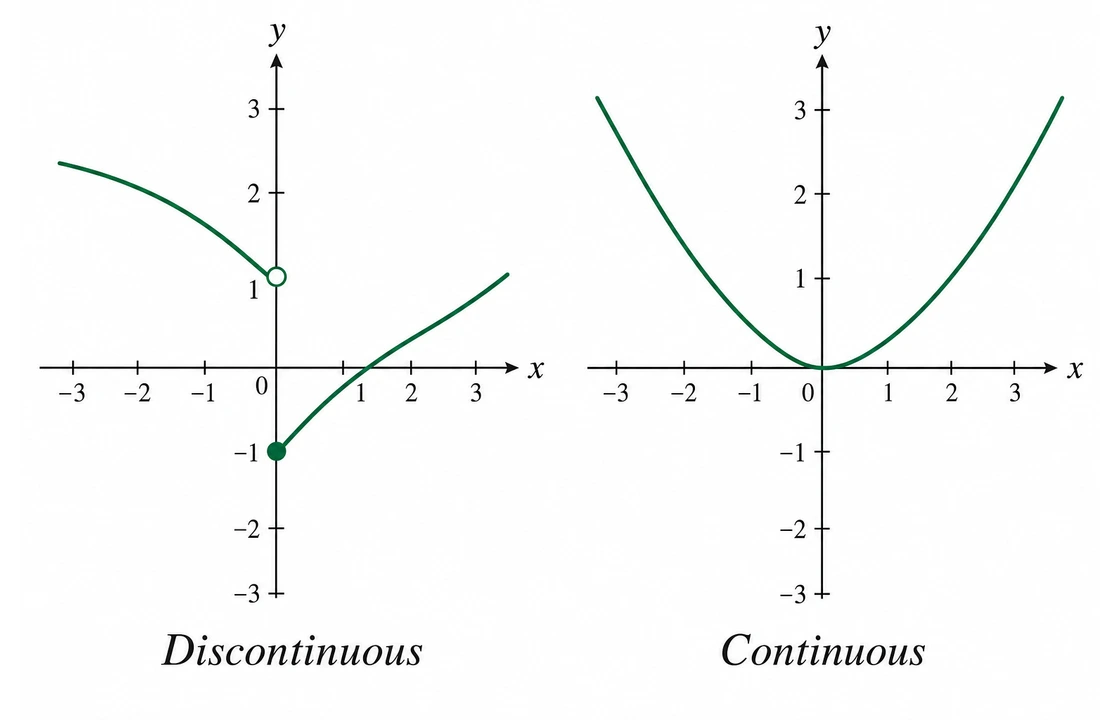
Look for any point where you would have to lift your pencil to keep drawing the curve. Holes (open circles), jumps between separate pieces of the graph, and vertical asymptotes where the graph shoots off toward infinity are all visual signs of discontinuity.
Continuous Function vs. Discontinuous Function
A continuous function at a point x = c satisfies three conditions: f(c) is defined, the limit as x approaches c exists, and the limit equals f(c). A discontinuous function fails at least one of these conditions at one or more points. You can draw a continuous function's graph without lifting your pencil; a discontinuous function's graph requires at least one lift.
Why It Matters
Many real-world quantities change abruptly rather than smoothly — tax brackets, shipping rates, and digital signals all involve discontinuous functions. Recognizing discontinuities is essential in calculus because key theorems like the Intermediate Value Theorem and the Fundamental Theorem of Calculus require continuity on an interval. Understanding where a function breaks helps you determine where standard calculus techniques apply and where special care is needed.
Common Mistakes
Mistake: Assuming a function is discontinuous just because it is defined piecewise.
Correction: A piecewise function can be perfectly continuous. What matters is whether the pieces connect smoothly at the boundary points — check that the limit from each side equals the function's value there.
Mistake: Confusing a removable discontinuity (hole) with a jump discontinuity.
Correction: At a removable discontinuity, the two-sided limit exists but doesn't match f(c) (or f(c) is undefined). At a jump discontinuity, the left-hand and right-hand limits are different values. The distinction matters because a removable discontinuity can be 'fixed' by redefining the function at that single point, while a jump cannot.
Related Terms
- Continuous Function — The opposite — no breaks in the graph
- Function — The general concept being classified
- Graph of an Equation or Inequality — Visual representation showing discontinuities
- Limit — Core tool used to test for continuity
- Asymptote — Vertical asymptotes cause infinite discontinuities
- Intermediate Value Theorem — Theorem that requires continuity to hold