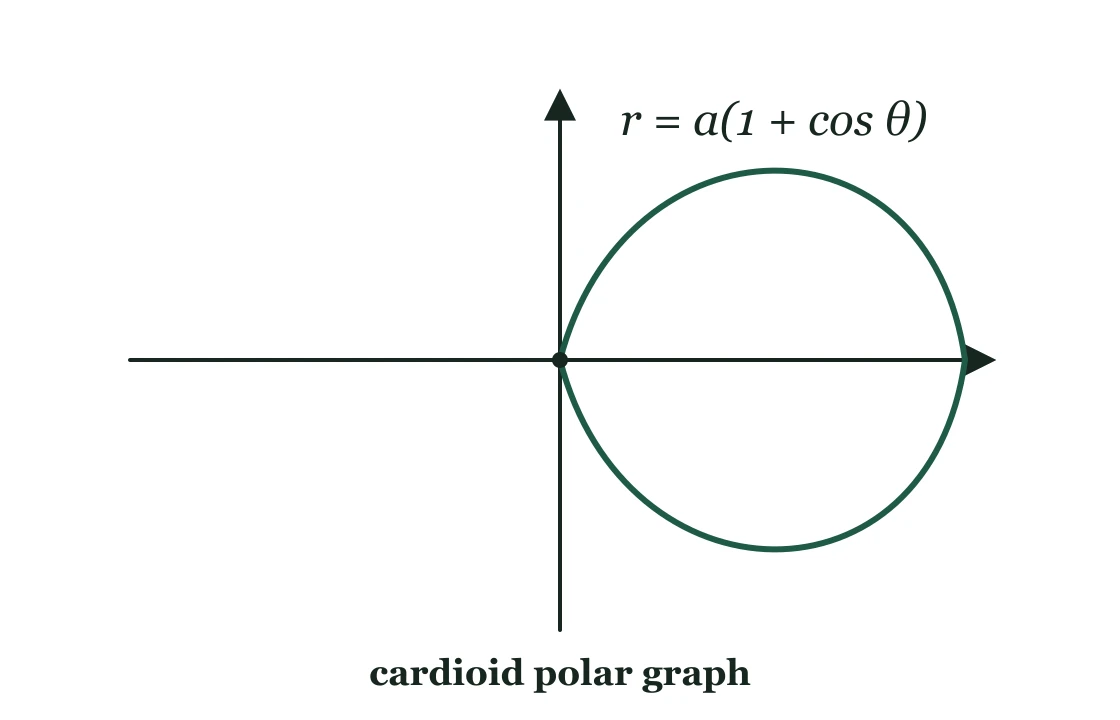
A curve that is somewhat heart shaped. A cardioid can
be drawn by tracing the path of a point on
a circle as the circle
rolls around a fixed circle of the
same radius.
The equation is usually written in polar
coordinates.
Note: A cardioid is a special case of the limaçon
family of curves.
Cardioid: r = a ± a cos θ (horizontal)
or r = a ± a sin θ (vertical)
r = The distance from the origin (pole) to a point on the curve
a = A positive constant that controls the size of the cardioid; the maximum value of r is 2a
θ = The angle measured from the positive x-axis (polar angle)
Worked Example
Problem: Find the key features of the cardioid r = 3 + 3 cos θ, and determine the coordinates of the point farthest from the origin.
Step 1: Identify the form. The equation matches r = a + a cos θ with a = 3, so this is a horizontal cardioid opening to the right.
r=3+3cosθ,a=3
Step 2: Find the maximum r. Since cos θ has a maximum value of 1, the farthest point occurs at θ = 0.
rmax=3+3(1)=6
Step 3: Find where r = 0 (the cusp). Set 3 + 3 cos θ = 0, which gives cos θ = −1, so the cusp is at θ = π.
3+3cosθ=0⟹cosθ=−1⟹θ=π
Step 4: Convert the farthest point to Cartesian coordinates. At θ = 0 and r = 6: x = 6 cos 0 = 6 and y = 6 sin 0 = 0.
x=6cos0=6,y=6sin0=0⇒(6,0)
Answer: The cardioid r = 3 + 3 cos θ has a maximum radius of 6, reached at the Cartesian point (6, 0), and a cusp at the origin when θ = π.
Another Example
This example applies integration to a cardioid, showing how to compute the enclosed area using the polar area formula — a common calculus exercise, unlike the first example which focused on identifying key features.
Problem: Find the area enclosed by the cardioid r = 2 + 2 sin θ.
Step 1: Recall the polar area formula. For a closed curve traced once as θ goes from 0 to 2π:
A=21∫02πr2dθ
Step 2: Substitute r = 2 + 2 sin θ and expand the square.
r2=(2+2sinθ)2=4+8sinθ+4sin2θ
Step 3: Use the identity sin²θ = (1 − cos 2θ)/2 to simplify.
r2=4+8sinθ+4⋅21−cos2θ=6+8sinθ−2cos2θ
Step 4: Integrate over [0, 2π]. The integrals of sin θ and cos 2θ over a full period are both 0, leaving only the constant term.
A=21∫02π(6+8sinθ−2cos2θ)dθ=21⋅6⋅2π=6π
Answer: The area enclosed by the cardioid r = 2 + 2 sin θ is 6π ≈ 18.85 square units.
Frequently Asked Questions
What is the difference between a cardioid and a limaçon?
A cardioid is a special case of the limaçon. The general limaçon has the form r = b + a cos θ. When b = a, the limaçon becomes a cardioid with a cusp at the origin. When b ≠ a, the curve is a limaçon that may have an inner loop (b < a), a dimple (a < b < 2a), or be convex (b ≥ 2a).
Why is a cardioid called 'heart-shaped'?
The name comes from the Greek word 'kardia,' meaning heart. When plotted, the curve has a rounded lobe on one side and a pointed cusp on the other, giving it a shape that loosely resembles a heart (or more precisely, the stylized heart symbol). The orientation depends on whether you use cos θ (horizontal) or sin θ (vertical).
How do you find the area of a cardioid?
Use the polar area formula A = (1/2)∫₀²π r² dθ. For any cardioid r = a + a cos θ (or the sin θ version), the enclosed area always equals 6πa²/4 = (3/2)πa², which simplifies nicely. For example, with a = 2, the area is 6π.
Cardioid vs. Limaçon
Cardioid
Limaçon
General form
r = a + a cos θ (coefficients equal)
r = b + a cos θ (coefficients can differ)
Cusp or loop?
Always has a cusp at the origin
May have an inner loop, dimple, or be convex
Condition
b = a
b and a are any positive values
Enclosed area
(3/2)πa²
Depends on both a and b
Relationship
Special case of limaçon
General family that includes the cardioid
Why It Matters
Cardioids appear in precalculus and calculus courses as a key example of polar curves, often used to practice polar graphing, finding areas, and computing arc lengths. They also show up in physics and engineering — for instance, many microphones have a "cardioid" pickup pattern, meaning they are most sensitive to sound from one direction, matching the shape of the curve. Understanding cardioids helps build intuition about how polar equations relate to the shapes they produce.
Common Mistakes
Mistake: Confusing cos θ and sin θ orientations: students assume r = a + a cos θ opens upward.
Correction: The cos θ form produces a cardioid symmetric about the horizontal (polar) axis, opening right (for +) or left (for −). The sin θ form is symmetric about the vertical axis, opening up (for +) or down (for −).
Mistake: Forgetting that both coefficients must be equal for a cardioid, writing something like r = 2 + 3 cos θ and calling it a cardioid.
Correction: If the constant term and the coefficient of cos θ (or sin θ) are not equal, the curve is a limaçon but not a cardioid. A cardioid requires the form r = a ± a cos θ or r = a ± a sin θ, where the two coefficients match.
Related Terms
Limaçon — General family of which a cardioid is a special case
Polar Coordinates — Coordinate system used to write cardioid equations
Polar Curves — Broader category that includes cardioids
Circle — Rolling circle construction defines the cardioid
Cycloid — Another curve defined by a rolling circle