Mathwords logoReference LibraryMathwords

Eccentricity

Eccentricity of a Conic Section

A number that indicates how drawn out or attenuated a conic section is. Eccentricity is represented by the letter e (no relation to e = 2.718...). For horizontal ellipses and hyperbolas, eccentricity Formula showing eccentricity e equals c divided by a, where c is distance to focus and a is distance to vertex.. For vertical ellipses and hyperbolas, eccentricity Formula showing eccentricity e equals c divided by b, written as e = c/b.. Here, c = the distance from the center to a focus, a = the horizontal distance from the center to the vertex, and b = the vertical distance from the center to the vertex.
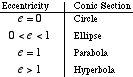
 

Table showing eccentricity values and corresponding conic sections: e=0 Circle, 0<e<1 Ellipse, e=1 Parabola, e>1 Hyperbola.


Interactive Feature

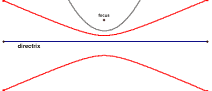
eccentricity snapshot
Conic Sections Defined by Eccentricity
Java Sketchpad version (Java enabled browser required)
Geometer's Sketchpad version (GSP 4 required)

Conic Sections Defined by Eccentricity
1. Move the slider for eccentricity and see what kind of conic section you get.
2. Move the focus to see what impact that has on the figure.
3. Move a point on the directrix to show that no matter what point is taken on the curve, the ratio of the distance to the focus over the distance to the directrix always equals the eccentricity.


See also

Parabola, circle

Key Formula

e=cae = \frac{c}{a}
Where:
  • ee = Eccentricity of the conic section
  • cc = Distance from the center to a focus
  • aa = Distance from the center to a vertex along the major axis (for an ellipse) or transverse axis (for a hyperbola)

Worked Example

Problem: Find the eccentricity of the ellipse x225+y29=1\frac{x^2}{25} + \frac{y^2}{9} = 1.
Step 1: Identify a2a^2 and b2b^2. Since 25>925 > 9, the major axis is horizontal with a2=25a^2 = 25 and b2=9b^2 = 9.
a=5,b=3a = 5, \quad b = 3
Step 2: Use the ellipse relationship c2=a2b2c^2 = a^2 - b^2 to find cc.
c2=259=16    c=4c^2 = 25 - 9 = 16 \implies c = 4
Step 3: Apply the eccentricity formula e=cae = \frac{c}{a}.
e=45=0.8e = \frac{4}{5} = 0.8
Step 4: Verify: Since 0<0.8<10 < 0.8 < 1, this confirms the conic is an ellipse. A value close to 11 means the ellipse is quite elongated.
Answer: The eccentricity of the ellipse is e=0.8e = 0.8.

Another Example

This example involves a hyperbola instead of an ellipse, highlighting the key difference: for hyperbolas, c2=a2+b2c^2 = a^2 + b^2 (addition), which always produces e>1e > 1.

Problem: Find the eccentricity of the hyperbola x29y216=1\frac{x^2}{9} - \frac{y^2}{16} = 1.
Step 1: Identify a2a^2 and b2b^2 from the standard form. For a hyperbola x2a2y2b2=1\frac{x^2}{a^2} - \frac{y^2}{b^2} = 1, we have a2=9a^2 = 9 and b2=16b^2 = 16.
a=3,b=4a = 3, \quad b = 4
Step 2: Use the hyperbola relationship c2=a2+b2c^2 = a^2 + b^2 to find cc. Note the plus sign — this is different from ellipses.
c2=9+16=25    c=5c^2 = 9 + 16 = 25 \implies c = 5
Step 3: Apply the eccentricity formula.
e=ca=531.667e = \frac{c}{a} = \frac{5}{3} \approx 1.667
Step 4: Verify: Since e>1e > 1, this confirms the conic is a hyperbola.
Answer: The eccentricity of the hyperbola is e=531.667e = \frac{5}{3} \approx 1.667.

Frequently Asked Questions

What does the eccentricity of a conic section tell you?
Eccentricity tells you the shape of the conic. A circle has e=0e = 0, an ellipse has 0<e<10 < e < 1, a parabola has e=1e = 1, and a hyperbola has e>1e > 1. The larger the eccentricity, the more "stretched out" or open the curve becomes. For an ellipse, as ee approaches 11, the shape gets longer and thinner.
Why does a circle have an eccentricity of 0?
A circle is a special ellipse where the two foci coincide at the center, so c=0c = 0. Since e=cae = \frac{c}{a} and c=0c = 0, the eccentricity equals 00. This makes intuitive sense because the circle has no "elongation" in any direction — it is perfectly round.
What is the eccentricity of a parabola and why?
A parabola has eccentricity e=1e = 1 exactly. This can be understood from the focus-directrix definition: for any point on a parabola, the distance to the focus equals the distance to the directrix, so their ratio is always 11. A parabola sits at the boundary between ellipses (e<1e < 1) and hyperbolas (e>1e > 1).

Ellipse eccentricity vs. Hyperbola eccentricity

Ellipse eccentricityHyperbola eccentricity
Range of e0 < e < 1e > 1
Relationship for cc² = a² − b²c² = a² + b²
Shape behavior as e increasesEllipse becomes more elongated, approaching a parabolaBranches open wider and flatten out
Special casee = 0 gives a circleNo upper bound on e
Number of branchesOne closed curveTwo open branches

Why It Matters

Eccentricity appears throughout precalculus and calculus courses whenever you classify or analyze conic sections. In physics and astronomy, planetary orbits are ellipses, and eccentricity determines how circular or elongated each orbit is — Earth's orbit has e0.017e \approx 0.017 (nearly circular), while comets often have ee close to or greater than 11. Understanding eccentricity also helps in engineering applications such as satellite dish design (parabolas, e=1e = 1) and whispering galleries (ellipses with specific eccentricity).

Common Mistakes

Mistake: Using the same formula c2=a2b2c^2 = a^2 - b^2 for both ellipses and hyperbolas.
Correction: For ellipses, c2=a2b2c^2 = a^2 - b^2. For hyperbolas, c2=a2+b2c^2 = a^2 + b^2. Mixing these up gives the wrong value of cc and therefore the wrong eccentricity. Remember: hyperbolas add, ellipses subtract.
Mistake: Confusing the eccentricity ee with Euler's number e2.718e \approx 2.718.
Correction: These are completely unrelated. The eccentricity ee is a geometric ratio that depends on the shape of a conic section. Context should make it clear which ee is intended: if you are working with conic sections, ee means eccentricity.

Related Terms