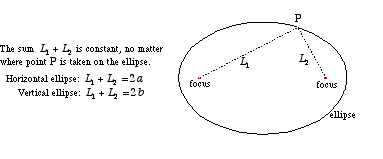
Two fixedpoints on the interior of an ellipse used in the formal definition of the curve. An ellipse is defined
as follows: For two given points, the foci, an ellipse is the locus of points such that the sum of the distance to each focus is constant.
Note:
If the interior of an ellipse is a mirror, all rays of light
emitting from one focus reflect off the inside and pass through
the other
focus.
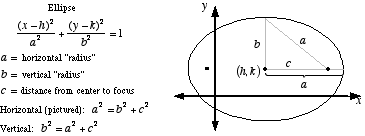
c = Distance from the center of the ellipse to each focus
a = Length of the semi-major axis (half the longest diameter)
b = Length of the semi-minor axis (half the shortest diameter)
Worked Example
Problem: Find the foci of the ellipse given by the equation x²/25 + y²/9 = 1.
Step 1: Identify a² and b² from the standard form equation. The larger denominator goes with a².
a2=25,b2=9
Step 2: Use the relationship c² = a² − b² to find c.
c2=25−9=16
Step 3: Take the square root to find c.
c=16=4
Step 4: Since a² = 25 is under x², the major axis is horizontal. The foci lie along the x-axis, at distance c from the center (0, 0).
Foci: (4,0) and (−4,0)
Answer: The foci are at (4, 0) and (−4, 0).
Another Example
This example differs because the ellipse has a non-origin center and a vertical major axis, requiring students to determine the correct direction for the foci and apply the center offset.
Problem: Find the foci of the ellipse given by (x − 2)²/9 + (y + 3)²/49 = 1.
Step 1: Identify the center of the ellipse from the equation. The center is at (h, k).
(h,k)=(2,−3)
Step 2: Identify a² and b². The larger denominator is a². Here 49 > 9, and 49 is under the y-term, so the major axis is vertical.
a2=49,b2=9
Step 3: Calculate c using c² = a² − b².
c2=49−9=40⇒c=40=210
Step 4: Since the major axis is vertical, the foci are above and below the center, shifted by c in the y-direction.
Foci: (2,−3+210) and (2,−3−210)
Answer: The foci are at (2, −3 + 2√10) and (2, −3 − 2√10), approximately (2, 3.32) and (2, −9.32).
Frequently Asked Questions
How do you find the foci of an ellipse?
Use the formula c² = a² − b², where a is the semi-major axis and b is the semi-minor axis. Solve for c. The foci are located at distance c from the center along the major axis. If the major axis is horizontal, the foci are at (h ± c, k); if vertical, at (h, k ± c).
What is the difference between the foci of an ellipse and the foci of a hyperbola?
For an ellipse, c² = a² − b², so c < a and both foci lie inside the curve. For a hyperbola, c² = a² + b², so c > a and the foci lie outside the curve (beyond the vertices). In an ellipse the sum of distances to the foci is constant, while in a hyperbola the difference of distances is constant.
Why does an ellipse have two foci?
An ellipse is defined as the set of all points where the sum of distances to two fixed points equals a constant. Those two fixed points are the foci. If both foci coincide at a single point, the ellipse becomes a circle — a special case where c = 0.
Foci of an Ellipse vs. Foci of a Hyperbola
Foci of an Ellipse
Foci of a Hyperbola
Definition
Two interior points where the sum of distances from any point on the curve is constant
Two exterior points where the absolute difference of distances from any point on the curve is constant
Formula for c
c² = a² − b²
c² = a² + b²
Location of foci
Inside the curve (c < a)
Outside the curve, beyond the vertices (c > a)
Special case when c = 0
Circle (both foci merge at center)
Not possible (c is always > 0)
Why It Matters
You encounter foci of an ellipse in precalculus, conic sections units, and standardized tests like the SAT and AP exams. Planetary orbits are ellipses with the Sun at one focus — this is Kepler's first law — so understanding foci connects algebra to physics. Engineers also use the reflective property of ellipses (signals bouncing between foci) when designing whispering galleries and satellite dish shapes.
Common Mistakes
Mistake: Using c² = a² + b² instead of c² = a² − b².
Correction: The formula c² = a² + b² applies to hyperbolas, not ellipses. For an ellipse, always subtract: c² = a² − b². Remember that the foci must lie inside the ellipse, so c must be less than a.
Mistake: Placing the foci along the wrong axis.
Correction: The foci always lie along the major (longer) axis. Check which denominator in the standard equation is larger: if a² is under x², the major axis is horizontal and foci are at (h ± c, k). If a² is under y², the major axis is vertical and foci are at (h, k ± c).