
Torus — Definition, Formula & Examples
Torus
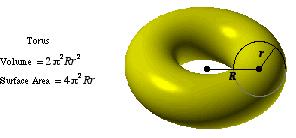
A doughnut shape. Formally, a torus is a surface of revolution obtained by revolving (in three dimensional space) a circle about a line which does not intersect the circle.
See also
Key Formula
V=2π2Rr2andA=4π2Rr
Where:
- V = Volume of the torus (the space enclosed by the surface)
- A = Surface area of the torus (the area of the outer skin)
- R = Major radius — the distance from the center of the torus to the center of the tube
- r = Minor radius — the radius of the circular tube itself
- π = Pi, approximately 3.14159
Worked Example
Problem: A torus has a major radius of R = 6 cm and a minor radius of r = 2 cm. Find its volume and surface area.
Step 1: Identify the two radii. The major radius R = 6 cm is the distance from the center of the hole to the center of the tube. The minor radius r = 2 cm is the radius of the tube's circular cross-section.
R=6 cm,r=2 cm
Step 2: Apply the volume formula. Substitute the values into the torus volume equation.
V=2π2Rr2=2π2(6)(22)=2π2(6)(4)=48π2
Step 3: Calculate the numerical volume.
V=48π2≈48×9.8696≈473.7 cm3
Step 4: Apply the surface area formula.
A=4π2Rr=4π2(6)(2)=48π2
Step 5: Calculate the numerical surface area.
A=48π2≈473.7 cm2
Answer: The torus has a volume of approximately 473.7 cm³ and a surface area of approximately 473.7 cm². (It is a coincidence that the numbers match here — this only happens when R·r² = R·r, i.e., when r = 1 or when the particular combination of R and r makes the expressions equal. In this case both expressions simplify to 48π².)
Another Example
This example uses different dimensions to show how quickly the volume grows as the radii increase, and focuses on volume alone to give a streamlined calculation.
Problem: A torus has a major radius of R = 10 cm and a minor radius of r = 3 cm. Find its volume.
Step 1: Write down the known values.
R=10 cm,r=3 cm
Step 2: Substitute into the volume formula.
V=2π2Rr2=2π2(10)(32)=2π2(10)(9)=180π2
Step 3: Evaluate numerically.
V=180π2≈180×9.8696≈1,776.5 cm3
Answer: The volume of the torus is approximately 1,776.5 cm³.
Frequently Asked Questions
What is the difference between the major radius and minor radius of a torus?
The major radius R is the distance from the center of the entire torus (the center of the hole) to the center of the tube. The minor radius r is the radius of the tube's circular cross-section. Think of R as how wide the doughnut is overall, and r as how thick the tube is. You always need both values to compute volume or surface area.
How do you derive the volume of a torus?
The volume formula comes from Pappus's centroid theorem. The theorem states that the volume of a solid of revolution equals the area of the revolved shape multiplied by the distance its centroid travels. The revolved shape is a circle with area πr², and its centroid travels a circular path of length 2πR. Multiplying gives V = πr² × 2πR = 2π²Rr².
What is a torus in real life?
Common real-life examples of tori include doughnuts, bagels, inner tubes, and life preservers. In engineering, O-rings used to seal pipes and joints are tori. The shape also appears in physics and astronomy — some models of the universe and magnetic confinement devices (tokamaks) use toroidal geometry.
Torus vs. Sphere
| Torus | Sphere | |
|---|---|---|
| Shape | Doughnut-shaped with a hole through the center | Perfectly round with no hole |
| Defined by | Two radii: major radius R and minor radius r | One radius: r |
| Volume formula | V = 2π²Rr² | V = (4/3)πr³ |
| Surface area formula | A = 4π²Rr | A = 4πr² |
| Generated by | Revolving a circle around an external axis | Revolving a semicircle around its diameter |
Why It Matters
The torus appears in multivariable calculus and differential geometry courses as a key example of a surface of revolution and a manifold. It is also central in physics — tokamak fusion reactors and particle accelerators use toroidal geometry. Understanding the torus builds your intuition about how rotating a 2D shape generates a 3D solid, a concept that extends to many engineering applications.
Common Mistakes
Mistake: Confusing the major radius R with the minor radius r, or swapping them in the formula.
Correction: Remember that R (major) is always the larger measurement — the distance from the center of the hole to the center of the tube. The minor radius r measures the tube's thickness. In the volume formula V = 2π²Rr², the minor radius r is squared, not R.
Mistake: Forgetting that the formulas require R > r for a standard (ring) torus with a visible hole.
Correction: If R ≤ r, the torus self-intersects or degenerates (a spindle torus or horn torus). The standard doughnut shape requires R > r. Most textbook problems assume this condition, but check before applying the formulas.
Related Terms
- Surface of Revolution — A torus is a specific surface of revolution
- Circle — The 2D shape that is revolved to form a torus
- Volume — Key measurement computed using the torus formula
- Surface Area — The outer area of the torus surface
- Axis of Rotation — The external line around which the circle revolves
- Three Dimensions — The space in which the torus exists
- Line — The axis that the generating circle revolves around