
Point of Division Formula
Point of Division Formula
The formula for the coordinates of a point which part of the way from one point to another.
Note: The midpoint formula is a special case of the point of division formula in which t = ½.
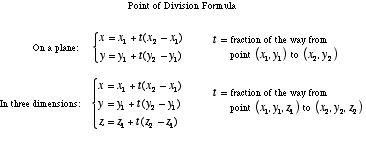
Key Formula
P=(x1+t(x2−x1),y1+t(y2−y1))
Where:
- (x1,y1) = Coordinates of the starting point $A$
- (x2,y2) = Coordinates of the ending point $B$
- t = The fraction of the way from $A$ to $B$, where $0 \le t \le 1$
- P = The resulting point of division
Worked Example
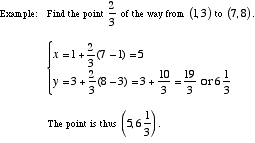
Problem: Find the point that is 1/4 of the way from A(2, 3) to B(10, 7).
Step 1: Identify the known values. Here A=(2,3), B=(10,7), and t=41.
x1=2,y1=3,x2=10,y2=7,t=41
Step 2: Apply the formula for the x-coordinate.
x=x1+t(x2−x1)=2+41(10−2)=2+41(8)=2+2=4
Step 3: Apply the formula for the y-coordinate.
y=y1+t(y2−y1)=3+41(7−3)=3+41(4)=3+1=4
Step 4: Write the final coordinates of the point of division.
P=(4,4)
Answer: The point 1/4 of the way from A(2, 3) to B(10, 7) is P(4, 4).
Another Example
This example shows how to convert a given ratio (e.g., 3:1) into the parameter t before applying the formula. Many textbook problems state the division as a ratio rather than a fraction.
Problem: Point P divides the segment from A(1, −2) to B(9, 6) in the ratio 3 : 1 (measured from A). Find the coordinates of P.
Step 1: Convert the ratio to the parameter t. A ratio of 3:1 from A means P is 3+13=43 of the way from A to B.
t=3+13=43
Step 2: Compute the x-coordinate using the formula.
x=1+43(9−1)=1+43(8)=1+6=7
Step 3: Compute the y-coordinate.
y=−2+43(6−(−2))=−2+43(8)=−2+6=4
Step 4: State the result.
P=(7,4)
Answer: The point that divides the segment from A(1, −2) to B(9, 6) in the ratio 3 : 1 is P(7, 4).
Frequently Asked Questions
How is the point of division formula related to the midpoint formula?
The midpoint formula is just the point of division formula with t=21. Substituting t=21 gives (2x1+x2,2y1+y2), which is exactly the midpoint. So the midpoint is a special case of the more general point of division.
How do you convert a ratio like m : n into the parameter t?
If a point divides segment AB in the ratio m:n from A, then t=m+nm. For example, a ratio of 2:3 means t=52, so the point is two-fifths of the way from A to B.
Does the order of the two points matter in the point of division formula?
Yes. The parameter t measures the fraction of the way from the first point to the second point. If you swap the two points, you must also adjust t. For instance, a point 31 of the way from A to B is 32 of the way from B to A.
Point of Division Formula vs. Midpoint Formula
| Point of Division Formula | Midpoint Formula | |
|---|---|---|
| Definition | Finds a point any fraction t of the way from A to B | Finds the point exactly halfway between A and B |
| Formula | (x1+t(x2−x1),y1+t(y2−y1)) | (2x1+x2,2y1+y2) |
| Parameter | Requires a value of t (or a ratio m:n) | No extra parameter needed (t=21 always) |
| When to use | When dividing a segment in any given ratio or fraction | When you only need the center of a segment |
Why It Matters
You encounter this formula in coordinate geometry whenever a problem asks you to divide a line segment in a given ratio—common in standardized tests and geometry courses. It also appears in computer graphics and physics for linear interpolation between two positions. Understanding this formula makes the midpoint formula feel like a natural special case rather than a separate fact to memorize.
Common Mistakes
Mistake: Confusing the direction: using t as the fraction from B to A instead of from A to B.
Correction: Always confirm which endpoint is your starting point. If you need the point 31 of the way from A to B, use A as (x1,y1) and B as (x2,y2) with t=31.
Mistake: Using a ratio like 2 : 3 directly as t=32 instead of t=52.
Correction: When given a ratio m:n, compute t=m+nm. The denominator is the sum of both parts of the ratio, not just the second part.
Related Terms
- Midpoint Formula — Special case with t = 1/2
- Coordinates — The output values of the formula
- Point — The geometric object being located
- Formula — General term for algebraic rules
- Section Formula — Alternate name used in many textbooks
- Linear Interpolation — Same concept applied in data and computing
- Distance Formula — Measures segment length, often used alongside