
Kite — Definition, Formula & Properties
Kite
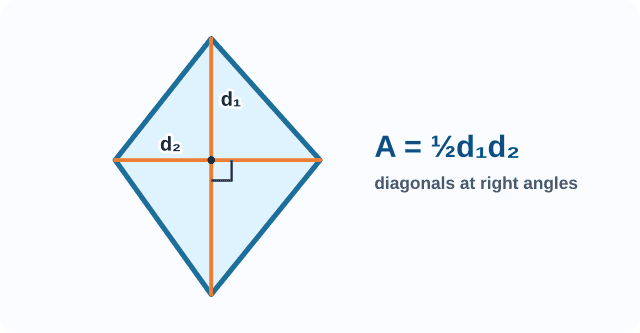
A quadrilateral with two pairs of adjacent sides that are congruent. Note that the diagonals of a kite are perpendicular.
Kite d1 = long diagonal of kite Area = (½) d1d2 |
|
See also
Key Formula
A=21d1⋅d2
Where:
- A = Area of the kite
- d1 = Length of the longer diagonal
- d2 = Length of the shorter diagonal
Worked Example
Problem: A kite has diagonals of length 10 cm and 6 cm. Find the area of the kite.
Step 1: Identify the two diagonals. Here, the longer diagonal is 10 cm and the shorter diagonal is 6 cm.
d1=10 cm,d2=6 cm
Step 2: Write the area formula for a kite.
A=21d1⋅d2
Step 3: Substitute the values into the formula.
A=21(10)(6)
Step 4: Multiply to get the area.
A=21(60)=30 cm2
Answer: The area of the kite is 30 cm².
Another Example
This example shows how the perpendicular diagonals of a kite can create right triangles. Once the missing diagonal is found, the area formula A = ½d₁d₂ can be used.
Problem: A kite has side lengths of 10 cm and 17 cm. Its symmetry diagonal is 21 cm. Find the shorter diagonal and the area of the kite.
Step 1: Let the symmetry diagonal be split into two parts, p and q, by the shorter diagonal. Let x be half of the shorter diagonal.
p+q=21
Step 2: The diagonals of a kite are perpendicular, so the side lengths form two right triangles.
p2+x2=102,q2+x2=172
Step 3: Subtract the first equation from the second to eliminate x².
q2−p2=172−102=189
Step 4: Use the difference of squares and p + q = 21.
(q−p)(q+p)=189,21(q−p)=189
Step 5: Solve for p and q.
q−p=9,q+p=21⟹q=15, p=6
Step 6: Find half of the shorter diagonal, then double it.
x2=102−62=64,x=8,d2=2x=16 cm
Step 7: Use the kite area formula.
A=21×21×16=168 cm2
Answer: The shorter diagonal is 16 cm, and the area of the kite is 168 cm².
Frequently Asked Questions
What is the difference between a kite and a rhombus?
A kite has two distinct pairs of adjacent congruent sides, whereas a rhombus has all four sides congruent. Every rhombus is technically a special case of a kite (where the two pairs happen to be equal), but most kites are not rhombuses. Both shapes have perpendicular diagonals, so they share the same area formula: A = ½ d₁ d₂.
Are the diagonals of a kite always perpendicular?
Yes. One of the defining properties of a kite is that its diagonals always intersect at right angles (90°). Additionally, the longer diagonal bisects the shorter diagonal, but the shorter diagonal does not necessarily bisect the longer one.
Can a kite have two right angles?
Yes. In many kites, the two angles where the unequal sides meet are not right angles, but a kite can have exactly two right angles. These right angles occur at the endpoints of the shorter diagonal. A square is a special kite that has four right angles.
Kite vs. Rhombus
| Kite | Rhombus | |
|---|---|---|
| Definition | Quadrilateral with two pairs of adjacent congruent sides (pairs can differ in length) | Quadrilateral with all four sides congruent |
| Diagonals | Perpendicular; longer diagonal bisects the shorter one | Perpendicular; each diagonal bisects the other |
| Area formula | A = ½ d₁ d₂ | A = ½ d₁ d₂ |
| Symmetry | One line of symmetry (along the longer diagonal) | Two lines of symmetry (along each diagonal) |
| Relationship | A rhombus is a special type of kite | A rhombus is also a parallelogram; a kite generally is not |
Why It Matters
Kites appear frequently in geometry courses when studying properties of quadrilaterals, diagonal relationships, and area formulas. Standardized tests often give you the diagonals of a kite and ask for the area, so knowing the formula A = ½ d₁ d₂ is essential. The perpendicular-diagonal property also makes kites a useful context for applying the Pythagorean theorem.
Common Mistakes
Mistake: Confusing adjacent congruent sides with opposite congruent sides.
Correction: In a kite, the two congruent sides in each pair are next to each other (adjacent), not across from each other. A quadrilateral with opposite sides congruent is a parallelogram, not a kite.
Mistake: Assuming both diagonals are bisected by the other.
Correction: Only the shorter diagonal is bisected by the longer one. The longer diagonal is not bisected by the shorter diagonal unless the kite is also a rhombus.
Related Terms
- Quadrilateral — A kite is a type of quadrilateral
- Rhombus — Special kite with all sides equal
- Square — Special case of both kite and rhombus
- Area of a Kite — Detailed formula and derivation
- Diagonal of a Polygon — Kite area depends on diagonal lengths
- Perpendicular — Kite diagonals meet at right angles
- Congruent — Adjacent sides of a kite are congruent in pairs
- Adjacent — Congruent sides in a kite are adjacent