Interior Angle
An angle on the interior of
a plane figure.
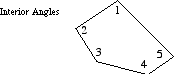
Examples: The angles
labeled 1, 2, 3, 4, and 5 in the pentagon below
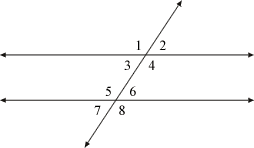
are all interior angles. Angles 3, 4, 5, and 6 in the second example
below are all interior angles as well (parallel
lines cut by a transversal).
Note: The sum of the interior angles
of an n-gon is given by the
formula (n – 2)·180°.
For a triangle this sum is 180°,
a quadrilateral 360°,
a pentagon 540°, etc.
Parallel lines cut
by a transversal |
 |
Worked Example
Problem: Find the sum of the interior angles of a hexagon (6-sided polygon).
Step 1: Identify the number of sides. A hexagon has 6 sides, so n = 6.
Step 2: Substitute into the interior angle sum formula.
S=(n−2)×180°=(6−2)×180° Step 3: Simplify inside the parentheses.
S=4×180° Step 4: Multiply to find the total sum.
Answer: The sum of the interior angles of a hexagon is 720°.
Another Example
This example differs by finding a single interior angle of a regular polygon, rather than just the total sum. It shows how to combine the sum formula with the equal-angle property of regular polygons.
Problem: A regular octagon (8 sides, all angles equal) is used in a stop sign design. Find the measure of each interior angle.
Step 1: Find the sum of the interior angles using the formula with n = 8.
S=(8−2)×180°=6×180°=1080° Step 2: Since the octagon is regular, all 8 interior angles are equal. Divide the total sum by the number of angles.
Each angle=81080° Step 3: Calculate the result.
Each angle=135° Answer: Each interior angle of a regular octagon measures 135°.
Frequently Asked Questions
What is the difference between an interior angle and an exterior angle?
An interior angle is formed inside a polygon between two adjacent sides. An exterior angle is formed outside the polygon between one side and the extension of an adjacent side. At any vertex, an interior angle and its corresponding exterior angle are supplementary — they add up to 180°. While the interior angle sum depends on the number of sides, the sum of exterior angles of any convex polygon is always 360°.
How do you find a missing interior angle of a polygon?
First, calculate the total sum of interior angles using (n – 2) × 180°. Then add up all the known angles and subtract that total from the sum. The result is the missing angle. For example, if a quadrilateral has three angles of 90°, 80°, and 110°, the missing angle is 360° – (90° + 80° + 110°) = 80°.
Why does the interior angle sum formula work?
Any polygon with n sides can be divided into (n – 2) non-overlapping triangles by drawing diagonals from a single vertex. Since each triangle's angles sum to 180°, the total for the whole polygon is (n – 2) × 180°. This triangulation argument works for every simple polygon, regardless of the number of sides.
Interior Angle vs. Exterior Angle
| Interior Angle | Exterior Angle |
|---|
| Definition | Angle formed inside a polygon between two adjacent sides | Angle formed outside a polygon between one side and the extension of the adjacent side |
| Sum formula (n-gon) | (n – 2) × 180° | Always 360° (convex polygon) |
| Relationship at a vertex | Interior + Exterior = 180° | Interior + Exterior = 180° |
| Each angle in a regular n-gon | ((n – 2) × 180°) / n | 360° / n |
| Example (equilateral triangle) | 60° | 120° |
Why It Matters
Interior angles appear throughout geometry courses, from proving triangle congruence to calculating unknown angles in complex figures. Architects, engineers, and designers rely on interior angle measurements when constructing shapes — for instance, the 135° interior angles of a regular octagon define the shape of a stop sign. Standardized tests such as the SAT and ACT regularly ask questions that require the interior angle sum formula.
Common Mistakes
Mistake: Using n × 180° instead of (n – 2) × 180° for the angle sum.
Correction: Remember to subtract 2 from the number of sides before multiplying by 180°. The subtraction accounts for the fact that a polygon with n sides splits into (n – 2) triangles, not n triangles.
Mistake: Confusing the total sum of interior angles with the measure of each individual interior angle.
Correction: The formula (n – 2) × 180° gives the total sum of all interior angles. To find each angle in a regular polygon, you must divide this sum by n. In an irregular polygon, individual angles can differ, so you need additional information to find each one.
