Mathwords logoReference LibraryMathwords

Inverse Cotangent

Inverse Cotangent

cot-1 ctg-1
Cot-1 Ctg-1
arccot arcctg
Arccot Arcctg

The inverse function of cotangent.

Basic idea: To find cot-1 1, we ask "what angle has cotangent equal to 1?" The answer is 45°. As a result we say cot-1 1 = 45°. In radians this is cot-1 1 = π/4.

More: There are actually many angles that have cotangent equal to 1. We are really asking "what is the simplest, most basic angle that has cotangent equal to 1?" As before, the answer is 45°. Thus cot-1 1 = 45° or cot-1 1 = π/4.

Details: What is cot-1 (–1)? Do we choose 135°, –45°, 315°, or some other angle? The answer is 135°. With inverse cotangent, we select the angle on the top half of the unit circle. Thus cot-1 (–1) = 135° or cot-1 (–1) = 3π/4.

In other words, the range of cot-1 is defined to be the angles on the upper half of the unit circle as pictured below. The range of cot-1 is restricted to (0, 180°) or (0, π).

Note: arccot refers to "arc cotangent", or the radian measure of the arc on a circle corresponding to a given value of cotangent.

Technical note: Since none of the six trig functions sine, cosine, tangent, cosecant, secant, and cotangent are one-to-one, their inverses are not functions. Each trig function can have its domain restricted, however, in order to make its inverse a function. Some mathematicians write these restricted trig functions and their inverses with an initial capital letter (e.g. Cot or Cot-1). However, most mathematicians do not follow this practice. This website does not distinguish between capitalized and uncapitalized trig functions.
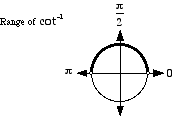
 

Unit circle showing the range of cot⁻¹: from 0 to π (excluding 0), with π/2 at top, labeled axes.


See also

Inverse trigonometry, inverse trig functions, interval notation

Key Formula

y=cot1(x)cot(y)=x,y(0,π)y = \cot^{-1}(x) \quad \Longleftrightarrow \quad \cot(y) = x, \quad y \in (0,\, \pi)
Where:
  • xx = Any real number (the domain of inverse cotangent is all real numbers)
  • yy = The output angle, strictly between 0 and π radians (0° and 180°), exclusive

Worked Example

Problem: Find the exact value of cot⁻¹(√3).
Step 1: Set up the equation. You need an angle y such that cot(y) = √3 and y is in (0, π).
cot(y)=3,y(0,π)\cot(y) = \sqrt{3}, \quad y \in (0, \pi)
Step 2: Rewrite in terms of tangent. Since cot(y) = 1/tan(y), you need tan(y) = 1/√3.
tan(y)=13\tan(y) = \frac{1}{\sqrt{3}}
Step 3: Recall which standard angle has tangent equal to 1/√3. From the unit circle, tan(π/6) = 1/√3.
y=π6y = \frac{\pi}{6}
Step 4: Verify the range. Since π/6 ≈ 30° is in the interval (0, π), this is valid.
0<π6<π0 < \frac{\pi}{6} < \pi \quad \checkmark
Answer: cot⁻¹(√3) = π/6, which equals 30°.

Another Example

This example uses a negative input, showing that the output falls in the second quadrant (between 90° and 180°) rather than the first quadrant.

Problem: Find the exact value of cot⁻¹(−√3).
Step 1: Set up the equation. You need an angle y such that cot(y) = −√3 and y is in (0, π).
cot(y)=3,y(0,π)\cot(y) = -\sqrt{3}, \quad y \in (0, \pi)
Step 2: Because the input is negative, the answer must lie in the second quadrant — between π/2 and π — where cotangent is negative.
y(π2,π)y \in \left(\frac{\pi}{2},\, \pi\right)
Step 3: You know that cot(π/6) = √3. The reference angle is π/6. In the second quadrant, the angle is π − π/6.
y=ππ6=5π6y = \pi - \frac{\pi}{6} = \frac{5\pi}{6}
Step 4: Check: cot(5π/6) = cos(5π/6)/sin(5π/6) = (−√3/2)/(1/2) = −√3. Correct, and 5π/6 is in (0, π).
cot ⁣(5π6)=3212=3\cot\!\left(\frac{5\pi}{6}\right) = \frac{-\frac{\sqrt{3}}{2}}{\frac{1}{2}} = -\sqrt{3} \quad \checkmark
Answer: cot⁻¹(−√3) = 5π/6, which equals 150°.

Frequently Asked Questions

What is the difference between inverse cotangent and inverse tangent?
Both find an angle from a ratio, but they have different ranges. The range of arctan is (−π/2, π/2), while the range of arccot is (0, π). Also, arccot(x) and arctan(1/x) are related but not identical for all x, because the range conventions differ — particularly for negative inputs.
What is the domain and range of inverse cotangent?
The domain of cot⁻¹(x) is all real numbers, meaning you can input any value from −∞ to +∞. The range is the open interval (0, π), so the output is always strictly between 0 and π radians (0° and 180°). The endpoints 0 and π are never reached.
Does cot⁻¹(0) exist, and what does it equal?
Yes. You need an angle y in (0, π) where cot(y) = 0. Cotangent equals zero when cosine equals zero, which happens at y = π/2. So cot⁻¹(0) = π/2, or 90°.

Inverse Cotangent (arccot) vs. Inverse Tangent (arctan)

Inverse Cotangent (arccot)Inverse Tangent (arctan)
Notationcot⁻¹(x) or arccot(x)tan⁻¹(x) or arctan(x)
DomainAll real numbers (−∞, ∞)All real numbers (−∞, ∞)
Range(0, π) — upper half of unit circle(−π/2, π/2) — right half of unit circle
Value at x = 0π/2 (90°)0 (0°)
Behavior for negative inputsOutput is in (π/2, π), always positiveOutput is in (−π/2, 0), negative
Relationshiparccot(x) = π/2 − arctan(x) for all xarctan(x) = π/2 − arccot(x) for all x

Why It Matters

Inverse cotangent appears in calculus when integrating expressions like 1/(1 + x²) using partial fractions or when solving differential equations. It also shows up in physics and engineering, for example when computing phase angles in AC circuits. Understanding its range is essential on the AP Calculus exam and in any course covering inverse trigonometric functions.

Common Mistakes

Mistake: Using the wrong range and giving a negative angle for a negative input.
Correction: The range of arccot is (0, π), so the output is always a positive angle. For negative inputs, the result falls between π/2 and π (second quadrant), never in the third or fourth quadrant.
Mistake: Confusing cot⁻¹(x) with 1/cot(x).
Correction: The notation cot⁻¹(x) means the inverse function (arccot), not the reciprocal. The reciprocal 1/cot(x) equals tan(x). Context and parentheses make the difference: cot⁻¹(x) is an angle, while [cot(x)]⁻¹ is a ratio.

Related Terms