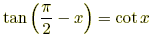
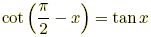
Cofunction Identities
Trig identities showing
the relationship between sine and cosine, tangent and cotangent,
and secant and cosecant. The value of
a trig function of an angle equals the value of the cofunction
of the complement of the angle.
Worked Example
Problem: Given that sin 40° = 0.6428 (approximately), find cos 50° without a calculator.
Step 1: Recognize that 40° and 50° are complementary angles because they add to 90°.
40°+50°=90° Step 2: Write 50° as the complement of 40°.
50°=90°−40° Step 3: Apply the cofunction identity: cosine of an angle equals sine of its complement.
cos50°=cos(90°−40°)=sin40° Step 4: Substitute the known value.
cos50°=0.6428 Answer: cos 50° ≈ 0.6428, obtained directly from the cofunction identity without a calculator.
Another Example
This example shows how cofunction identities are used to simplify algebraic trig expressions, rather than evaluating a numerical angle.
Problem: Simplify the expression tan(π/2 − θ) · sin θ and write it in terms of cos θ only.
Step 1: Apply the cofunction identity for tangent.
tan(2π−θ)=cotθ Step 2: Rewrite cotangent in terms of sine and cosine.
cotθ=sinθcosθ Step 3: Multiply by sin θ and simplify.
sinθcosθ⋅sinθ=cosθ Answer: tan(π/2 − θ) · sin θ simplifies to cos θ.
Frequently Asked Questions
Why are they called cofunction identities?
The prefix 'co-' in cosine, cotangent, and cosecant stands for 'complement.' Each of these functions is the cofunction of its partner (sine, tangent, secant). The identities are named 'cofunction' because they link a function with its complement-based partner.
Do cofunction identities work for angles greater than 90°?
Yes. The identities hold for all real values of the angle, not just acute angles. They are derived from the angle-subtraction formulas for sine and cosine, which are valid for every real number. So sin(90° − 200°) = cos 200° is perfectly valid.
How do you remember the cofunction identities?
Remember one key idea: a trig function of an angle equals its co-partner evaluated at the complement. Sine pairs with cosine, tangent pairs with cotangent, and secant pairs with cosecant. If you know sin(90° − x) = cos x, the rest follow the same pattern.
Cofunction Identities vs. Pythagorean Identities
| Cofunction Identities | Pythagorean Identities |
|---|
| What they relate | A function to its cofunction at the complementary angle | Squares of trig functions to each other (e.g., sin²x + cos²x = 1) |
| Key formula | sin(90° − x) = cos x | sin²x + cos²x = 1 |
| Main use | Rewriting a trig function in terms of its complement partner | Eliminating one trig function using a squared relationship |
| Involves complements? | Yes — the identity is built around 90° − x | No — the identity relates functions of the same angle x |
Why It Matters
Cofunction identities appear frequently on standardized tests (SAT, ACT, AP Calculus) where you must recognize that two complementary angles share trig values. They are essential when simplifying expressions in trigonometry and pre-calculus, and they help explain why the sine and cosine graphs are horizontal shifts of each other by π/2. Understanding cofunctions also deepens your grasp of right-triangle trigonometry, where the two acute angles are always complementary.
Common Mistakes
Mistake: Subtracting from 180° instead of 90°.
Correction: Cofunction identities use the complement (90° or π/2), not the supplement (180° or π). Supplementary angle relationships are different identities entirely — for example, sin(180° − x) = sin x, not cos x.
Mistake: Pairing the wrong functions together, such as thinking sin(90° − x) = tan x.
Correction: Each function pairs only with its 'co-' partner: sine ↔ cosine, tangent ↔ cotangent, secant ↔ cosecant. The 'co-' prefix is the clue.