Mathwords logoReference LibraryMathwords

Bearing

Bearing

Two similar ways of indicating direction. On the left below is a kind of bearing which uses compass points. The bearing S34°E means the direction is 34° away from due south directed towards the east. The other way, on the right below, measures the angle clockwise from due north.
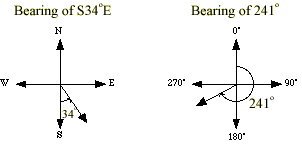
 

Two bearing diagrams: S34°E shown on compass with N/S/E/W axes; 241° shown clockwise from 0° (north) on circular diagram.

Worked Example

Problem: A ship sails from port on a three-figure bearing of 135°. What compass direction is this?
Step 1: Start at due north (0°) and measure 135° clockwise.
Step 2: Due east is 90° and due south is 180°. Since 135° is exactly halfway between east (90°) and south (180°), the direction is southeast.
135°=90°+45°135° = 90° + 45°
Step 3: In compass-point notation this is written S45°E (45° from due south toward the east).
Answer: A bearing of 135° corresponds to the direction S45°E, which is exactly southeast.

Why It Matters

Bearings are essential in navigation for ships, aircraft, and hikers using a compass. They give an unambiguous way to communicate direction so that two people always interpret the same angle the same way. Many trigonometry and geometry problems use bearings to set up real-world distance and direction calculations.

Common Mistakes

Mistake: Measuring the angle counterclockwise or from a direction other than north.
Correction: Three-figure bearings are always measured clockwise starting from due north. For example, due west is 270°, not 90°.

Related Terms

  • ClockwiseBearings are measured in the clockwise direction
  • AngleA bearing is expressed as an angle
  • Compass PointsCompass-point bearings use N, S, E, W references
  • TrigonometryUsed to solve bearing and distance problems