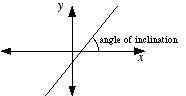
The angle between
a line and the x-axis.
This angle is always between 0° and 180°, and is
measured counterclockwise from
the part of the x-axis
to the right of the line.
Note: All horizontal lines
have angle of inclination 0°. All vertical lines
have angle of inclination 90°. Also, the slope
of a line is given by the tangent of
the angle of inclination.
Key Formula
m=tan(θ)
Where:
m = Slope of the line
θ = Angle of inclination, measured counterclockwise from the positive x-axis to the line (0° ≤ θ < 180°)
Worked Example
Problem: A line has a slope of 1. Find its angle of inclination.
Step 1: Write the relationship between slope and angle of inclination.
m=tan(θ)
Step 2: Substitute the known slope.
1=tan(θ)
Step 3: Solve for θ by taking the inverse tangent. Since the slope is positive, the angle is between 0° and 90°.
θ=arctan(1)=45°
Answer: The angle of inclination is 45°.
Another Example
Problem: A line has a slope of −√3. Find its angle of inclination.
Step 1: Use the slope-angle relationship.
m=tan(θ)
Step 2: Substitute the slope.
−3=tan(θ)
Step 3: The reference angle where tan equals √3 is 60°. Since the slope is negative, the angle of inclination must be in the range 90° < θ < 180°. Subtract the reference angle from 180°.
θ=180°−60°=120°
Answer: The angle of inclination is 120°.
Frequently Asked Questions
How do you find the angle of inclination from a slope?
Use the formula θ = arctan(m), where m is the slope. If arctan gives you a negative result (which happens when the slope is negative), add 180° to get the angle of inclination. This ensures the angle falls in the required range of 0° to 180°.
Why is the angle of inclination always between 0° and 180°?
A line extends in two opposite directions, so it intersects the positive x-axis at two supplementary angles. By convention, we pick the angle measured counterclockwise from the positive x-axis, which restricts the range to 0° ≤ θ < 180°. This gives every non-vertical line a unique angle of inclination.
Angle of Inclination vs. Slope
Slope is a ratio (rise over run) that can be any real number or undefined. Angle of inclination is an angle always between 0° and 180°. A horizontal line has slope 0 and inclination 0°. A vertical line has undefined slope but inclination exactly 90°.
Why It Matters
The angle of inclination gives a geometric way to think about slope. In physics, it describes the tilt of ramps and surfaces, which directly affects forces in problems involving friction and gravity. In analytic geometry and calculus, converting between slope and angle is essential when working with direction vectors, tangent lines to curves, and the angle between two intersecting lines.
Common Mistakes
Mistake: Using arctan of a negative slope and accepting the negative angle as the answer.
Correction: The angle of inclination must be between 0° and 180°. If arctan(m) returns a negative value, add 180° to bring the angle into the correct range. For example, arctan(−1) = −45°, so the angle of inclination is −45° + 180° = 135°.
Mistake: Measuring the angle clockwise from the x-axis or from the wrong part of the x-axis.
Correction: Always measure counterclockwise starting from the positive x-axis (the part to the right). Measuring clockwise or from the negative x-axis will give the wrong angle.
Related Terms
Slope of a Line — Equals the tangent of the inclination angle